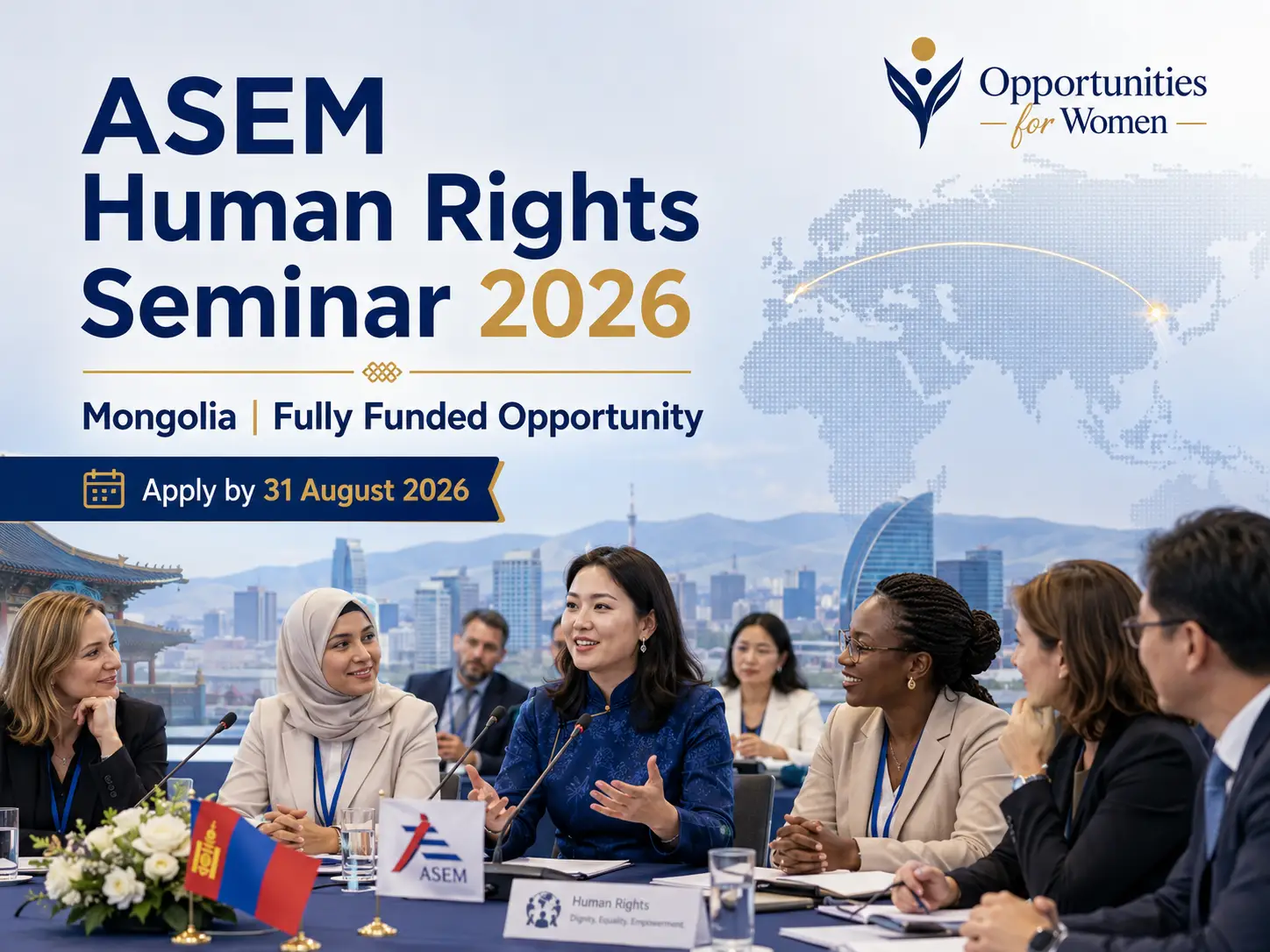
Deadline: Monday, 31 August 2026, at 23:59 Singapore Time.
Country: Ulaanbaatar, Mongolia.
Human Rights Seminar 2026 is an important international opportunity for human rights practitioners, civil society representatives, academics, researchers, government officials, National Human Rights Institutions, and international development professionals from Asia and Europe. The 24th Informal Seminar on Human Rights, officially titled “The Future of Human Rights – From Local to Global,” will take place from 12 to 14 October 2026 in Ulaanbaatar, Mongolia. A follow-up capacity-building programme will also be held from 15 to 16 October 2026 for selected seminar participants.
This opportunity is especially relevant for women working in human rights, law, governance, public policy, advocacy, academia, civil society, youth leadership, international relations, social justice, and sustainable development. The seminar creates a platform for participants to exchange ideas, examine current human rights challenges, strengthen cross-regional cooperation, and contribute practical recommendations for protecting human rights in a rapidly changing world
The ASEM Human Rights Seminar 2026 is organised under the Informal ASEM Seminar on Human Rights Series and hosted by the National Human Rights Commission of Mongolia in partnership with the Ministry of Foreign Affairs of Mongolia. The programme is supported by the Asia-Europe Foundation (ASEF) and other ASEM partners. Selected participants will benefit from covered accommodation, meals during the programme, and, for eligible civil society representatives, support for economy-class airfare to and from Ulaanbaatar.
For women and young professionals who want to expand their influence in human rights policy, governance, civil society, advocacy, research, and international cooperation, this seminar offers a valuable opportunity to learn, contribute, network, and strengthen their leadership in the human rights field.
Who Can Apply for the ASEM Human Rights Seminar
The ASEM Human Rights Seminar 2026 is designed for a wide range of stakeholders from Asia and Europe. The seminar particularly targets people and institutions that are actively engaged in human rights, governance, legal reform, public policy, civil society, research, and international cooperation.
Eligible and relevant applicants may include
- Government representatives working on human rights policy and implementation
- Representatives of National Human Rights Institutions and ombuds institutions,
- Civil society organisations,
- Human rights practitioners,
- Youth organisations working on human rights,
- Academics, researchers,
- Legal experts,
- International, regional, and intergovernmental organisations.
All participants must be citizens of ASEM partner countries and must have working proficiency in English. This means applicants should be able to understand, contribute to, and participate meaningfully in seminar discussions conducted in English.
Women applicants who work in human rights advocacy, gender equality, access to justice, legal aid, public interest research, youth leadership, governance, development, education, migration, disability rights, climate justice, digital rights, or community organising are strongly encouraged to consider this opportunity if they meet the eligibility requirements.
Benefits of the ASEM Human Rights Seminar
The ASEM Human Rights Seminar offers several important benefits for selected participants. According to the official opportunity information, the co-organisers will cover
- Accommodation for the duration of the seminar and training programme, as well as meals.
For selected civil society representatives, the co-organisers will also
- cover economy-class airfare to and from Ulaanbaatar, Mongolia, reimbursed up to a maximum ceiling. This travel support is particularly important because it can make the opportunity more accessible for human rights practitioners and civil society actors who may not have institutional funding to attend international programmes.
For women in human rights and governance, these benefits can be significant. The seminar may help participants build international visibility, strengthen professional credibility, expand networks, learn from experienced experts, and identify new strategies for advocacy and institutional change.
Why Women Should Apply
Women should consider applying for the ASEM Human Rights Seminar because human rights systems need diverse leadership, lived experience, and inclusive decision-making. Women are often at the frontlines of human rights work, whether through legal advocacy, community mobilisation, social services, journalism, education, peacebuilding, humanitarian work, research, or public policy. By joining the seminar, women participants can contribute gender-sensitive perspectives to wider human rights conversations. They can also learn from other regions and sectors, build partnerships, and return home with stronger tools for advocacy and institutional engagement
Application Process
Interested applicants for the ASEM Human Rights Seminar must complete the online application form by the official deadline. The deadline is Monday, 31 August 2026, at 23:59 Singapore Time. Applicants should prepare carefully before starting the application. They may need to provide personal information, professional background, institutional affiliation, relevant experience, motivation for applying, and interest in the follow-up capacity-building programme. Since the seminar is discussion-based, applicants should clearly explain how their work relates to human rights and how they intend to contribute to the seminar.
A strong application should show knowledge of human rights issues, practical experience or serious engagement, and a clear reason for wanting to participate. Applicants should avoid generic statements and instead explain how their work connects with the seminar’s theme. For example, an applicant working on women’s legal rights could explain how local legal barriers connect with national policy and international standards. A researcher working on digital rights could explain how technology affects privacy, equality, civic space, or democratic participation. A youth advocate could explain how young people can contribute to future human rights protection.
Applicants interested in the capacity-building programme from 15 to 16 October 2026 should indicate their interest directly in the application form. The organisers will share further details after the initial screening and once the seminar application deadline has closed.
How to Apply for the ASEM Human Rights Seminar
To apply for the ASEM Human Rights Seminar, visit the official opportunity page on the Asia-Europe Foundation website and complete the online application form before the deadline.
Applicants should follow these steps:
- Read the full official call for applications carefully. Make sure you understand the seminar dates, location, eligibility requirements, participant expectations, funding coverage, and deadline.
- Confirm that you are a citizen of an ASEM partner country. You can review the list of ASEM partners through the official ASEM information resources.
- Prepare your application materials. This may include your professional background, current role, human rights experience, motivation statement, and explanation of how you will share the seminar outcomes with your organisation or network.
- Complete the online application form before 31 August 2026, 23:59 Singapore Time. Do not wait until the last day, especially if you need to prepare thoughtful written responses.
- Indicate whether you are interested in the follow-up capacity-building programme if you wish to be considered.
- Finally, check your email regularly after submission for any updates, requests for clarification, or selection communication from the organisers.
Official Link
Applicants should apply through the official Asia-Europe Foundation opportunity page:
Internal Resources for Applicants
Applicants may also find related opportunities and resources on Opportunities for Women useful. If you are building your career in human rights, governance, advocacy, or international development, you can explore more opportunities through the following links below:
Fellowships for Women
Grants for Women
International Conferences for Women
Scholarships for Women
Leadership Programs for Women
Internships and Training OpportunitiesThese internal links can help readers discover more programmes related to women’s leadership, international cooperation, public policy, education, civil society, and professional development.