
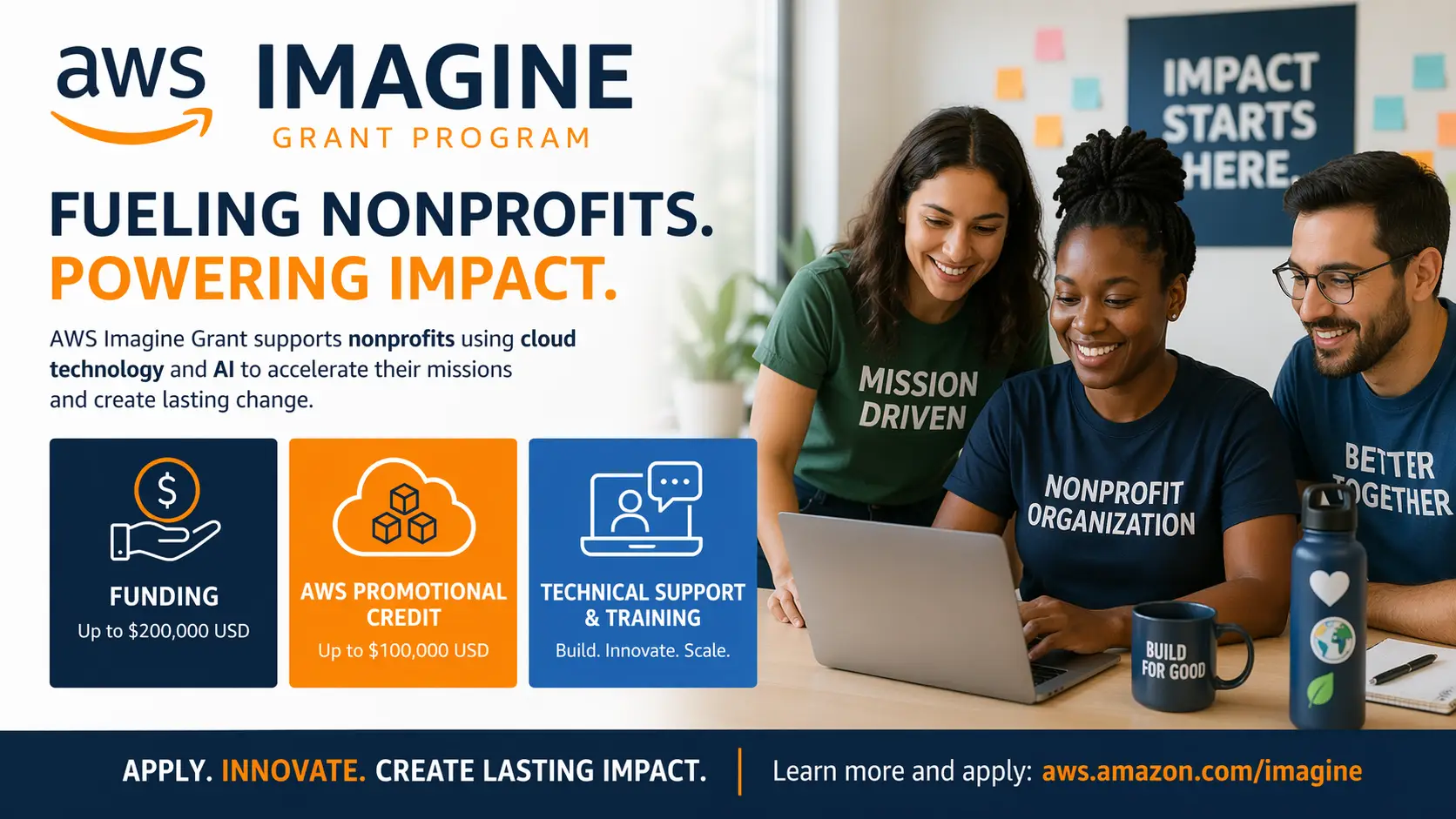
AWS Imagine Grant is a standout opportunity for nonprofits that want to use cloud technology, data, and artificial intelligence to expand their impact. For many organizations, the challenge is not a lack of ideas. It is having the funding, infrastructure, and technical support to turn a promising concept into a practical, scalable solution. According to Amazon Web Services, the program is a public grant opportunity for registered nonprofit organizations using cloud technology to accelerate their missions.
For organizations working in economic empowerment, education, health, community development, or gender equality, the right digital tools can improve service delivery, strengthen operations, and help teams reach more people. That is why AWS Imagine Grant deserves serious attention from women-led nonprofits and social impact organizations looking for a technology-focused funding opportunity.
Why the AWS Imagine Grant matters
Technology is now central to how many nonprofits deliver services, track outcomes, protect sensitive information, and communicate with supporters. Yet a large number of organizations still operate with fragmented systems, outdated infrastructure, or limited technical capacity. AWS Imagine Grant is significant because it offers more than a cash award. AWS says selected organizations may receive unrestricted funding, AWS Promotional Credit, technical guidance, training, and potential marketing visibility.
That combination matters because digital transformation usually requires more than money alone. A nonprofit might have a compelling idea, but still need cloud credits, architecture support, or implementation guidance to make the project work. This program is built for organizations that want to modernize, test a pilot, expand an existing initiative, or develop a new technology-enabled service.
AWS Imagine Grant award categories
AWS lists three primary U.S. award categories for the 2026–2027 cycle. Each category aligns with a different stage of technology maturity and project ambition. Choosing the right fit matters because reviewers will want to see alignment between the proposed project and the category criteria.
Pathfinder Award
The Pathfinder Award is designed for mission-critical projects using frontier AI. AWS highlights examples such as generative AI, agentic AI, and autonomous systems. This category is intended for nonprofits with strong data practices that are already planning advanced AI work.
AWS says Pathfinder recipients may receive up to $200,000 USD in unrestricted funding, up to $100,000 USD in AWS Promotional Credit, implementation support from the AWS Generative AI Innovation Center, training, and possible AWS marketing promotion.
Go Further, Faster Award
The Go Further, Faster Award supports highly innovative cloud-based projects with potential to create scaled and repeatable impact. AWS notes that these projects may involve advanced services such as AI, machine learning, high performance computing, or Internet of Things technologies.
According to AWS, this category may provide up to $150,000 USD in unrestricted funding, up to $100,000 USD in AWS Promotional Credit, technical implementation guidance, training, and possible marketing promotion.
Momentum to Modernize Award
The Momentum to Modernize Award is aimed at foundational digital transformation work. AWS says it can support efforts such as server migration, net-new application development, database migration and centralization, and infrastructure expansion.
AWS says organizations selected in this category may receive up to $50,000 USD in unrestricted funding, up to $20,000 USD in AWS Promotional Credit, technical guidance, training, and possible marketing promotion. For nonprofits earlier in their cloud journey, this may be the most practical entry point.
Who can apply
- AWS says nonprofit organizations with registered 501(c) status in the United States are eligible to apply,
- Including 501(c)(3) organizations and some other 501(c)-designated entities.
- AWS also notes that organizations of any annual budget size may apply and that all causes and mission areas are welcome.
- Educational institutions, including schools, colleges, and universities, are excluded from the current priority funding areas.
- AWS FAQ materials also say the broader program is currently available in the United States, United Kingdom, Ireland, Canada, Australia, and New Zealand.
- Because eligibility rules can vary by country page, applicants should always check the official page that applies to their location before submitting.
AWS Imagine Grant timeline and deadlines
AWS says proposals are accepted once annually.
Round One guidelines and application access open on March 19, 2026; Round One closes on June 5, 2026; Round One results and Round Two invitations are sent on July 14, 2026;
Round Two opens on August 10, 2026; Round Two closes on September 14, 2026; results are communicated in mid-November 2026; and
Winners are publicly announced on December 1, 2026.
Because the second round is invitation-only, nonprofits should treat the initial application as a serious and competitive screening step. Strong proposals will need a clear problem statement, a realistic technical plan, and measurable outcomes.
What AWS looks for in applications
AWS says applications are judged using factors such as innovation, mission impact, clearly defined outcomes, well-defined milestones, the applicability of AWS services, sustainability, completeness, and compliance with submission requirements.
That means a strong AWS Imagine Grant application should show more than a worthy mission. It should explain the problem clearly, outline the proposed technical solution, define realistic milestones, show how success will be measured, and describe how the work can continue after the grant period ends.
How to choose the right category
AWS guidance suggests applicants should choose the category that best matches their current project stage rather than simply targeting the largest possible award. For example, an organization planning to use AI later but still building a data foundation today may be better suited to Momentum to Modernize than Pathfinder.
In practical terms, Momentum to Modernize is a fit for foundational upgrades, Go Further, Faster is better for innovative cloud-based projects with scaling potential, and Pathfinder is strongest for advanced AI work backed by mature data practices.
Why this matters for women led nonprofits
For women-led nonprofits and organizations serving women and girls, AWS Imagine Grant can be especially meaningful. Many of these organizations are doing critical work with lean teams and limited technology budgets. A grant that combines funding with technical support can help them build stronger systems behind programs that already matter deeply in their communities.
A nonprofit supporting women entrepreneurs might use the grant to build a scalable learning platform or resource hub. A community health organization could modernize secure data systems to improve coordination and reporting. A workforce development nonprofit could centralize participant data to track outcomes more effectively and strengthen future fundraising.
Final thoughts
AWS Imagine Grant is more than a funding opportunity. It is a strategic opportunity for nonprofits that want to treat technology as a mission-critical part of their work. AWS also notes that organizations do not need to already be using AWS to apply, provided the proposed solution is well suited to AWS technologies.
For Opportunitiesforwomen.org readers, this program is worth watching closely. The strongest applicants will likely be the ones that connect a real mission challenge to a realistic, well-planned digital solution. Before publishing or applying, it is wise to review the official guidelines, confirm current deadlines, and make sure the chosen category truly matches the project’s stage and ambition.