Country: United States of America (USA)
Deadline: 30 September 2026
Opportunity Summary
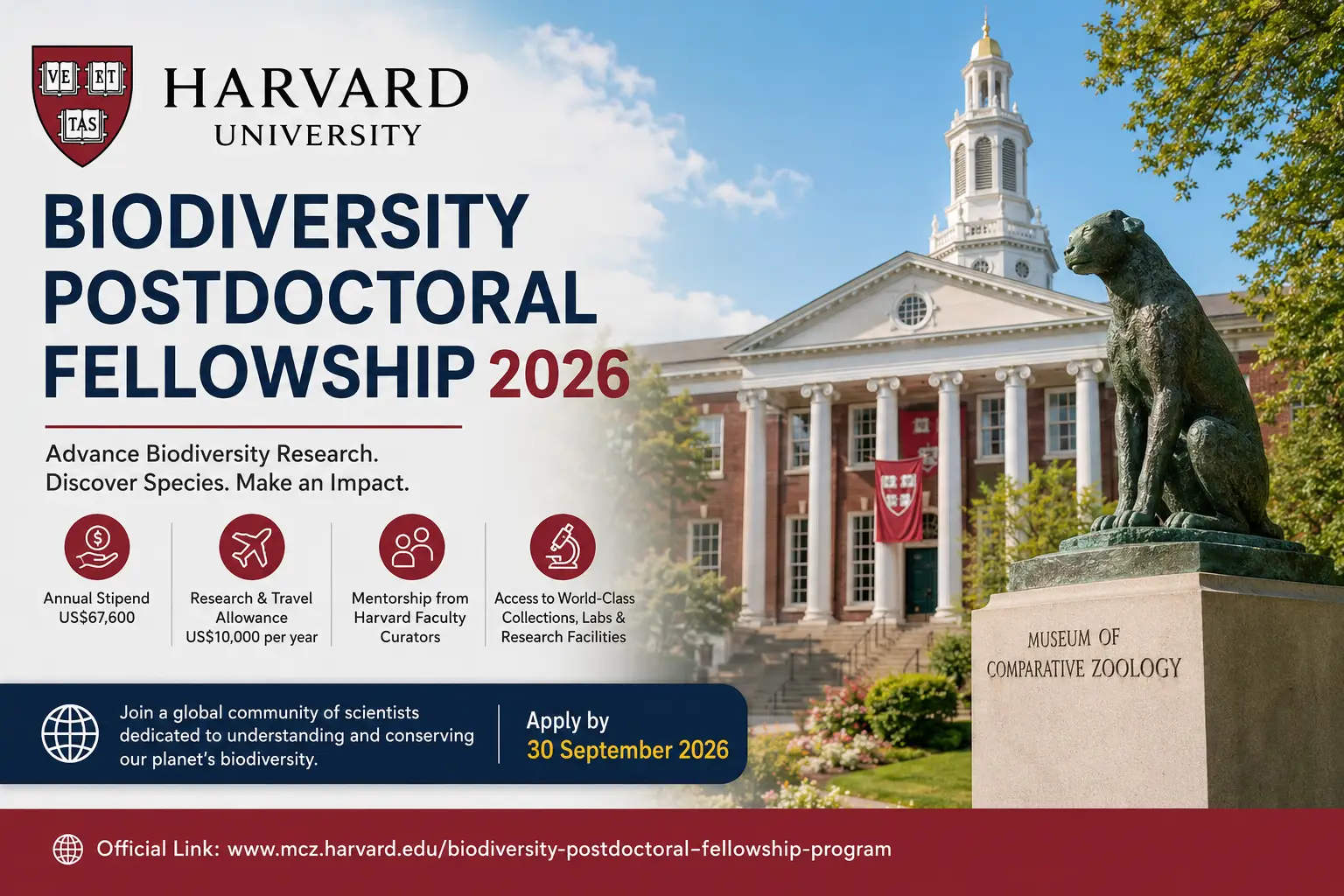
The Harvard University Biodiversity Postdoctoral Fellowship 2026 is now accepting applications from outstanding early-career researchers who are passionate about biodiversity, taxonomy, and systematics. Hosted by the Museum of Comparative Zoology (MCZ) at Harvard University, this prestigious fellowship supports scientists dedicated to discovering, documenting, and formally describing Earth’s biodiversity.
The fellowship is designed to advance taxonomic research while strengthening global knowledge of animal diversity. Fellows will conduct independent research under the mentorship of one or more Harvard faculty-curators, gaining access to world-class museum collections, laboratory facilities, research infrastructure, and collaborative scientific networks.
Researchers from around the world are encouraged to apply. The fellowship welcomes both U.S. and international applicants and particularly encourages innovative projects that combine traditional taxonomy with modern scientific approaches such as genomics, molecular biology, imaging, bioinformatics, ecology, and evolutionary biology.
Applicants interested in pursuing additional international fellowships, scholarships, research grants, and academic opportunities can also explore the extensive collection available at Opportunities for Women.
Despite centuries of biological research, scientists estimate that millions of species remain undescribed worldwide. Understanding biodiversity has become increasingly urgent due to habitat destruction, climate change, invasive species, pollution, and global biodiversity loss.
This fellowship allows researchers to make meaningful scientific contributions while working alongside internationally recognized experts.
Unlike many postdoctoral programs that focus on narrow research topics, this fellowship welcomes projects involving virtually any animal taxonomic group—living or extinct. Botanists researching plant-animal interactions are also encouraged to apply.
Why This Fellowship Matters
Taxonomy forms the foundation of biodiversity conservation. Without knowing which species exist, conservation planning becomes significantly more difficult.
Successful fellows contribute by:
- Discovering species new to science
- Publishing taxonomic revisions
- Improving biodiversity databases
- Strengthening museum collections
- Supporting conservation policy
- Advancing evolutionary biology
- Building international scientific collaborations
The fellowship provides an exceptional opportunity for researchers wishing to establish themselves as future leaders in biodiversity science.
Research Environment at Harvard University
The Museum of Comparative Zoology houses one of the world’s largest and most important biological collections.
Fellows benefit from:
- Millions of preserved biological specimens
- Extensive fossil collections
- Modern molecular laboratories
- Advanced imaging facilities
- Genomic resources
- Collaborative research groups
- Harvard University’s extensive library system
- Cross-disciplinary partnerships
Faculty mentors help fellows refine research questions, develop publications, and expand professional networks.
Funding Coverage
The Harvard Biodiversity Postdoctoral Fellowship offers an excellent financial package that enables fellows to focus entirely on research.
Successful applicants receive:
- Annual stipend of US$67,600
- Full employee benefits
- Research and travel allowance of US$10,000 per year
- Relocation allowance
- Office space
- Laboratory access
- Research support
- Access to Harvard collections and museum resources
- Mentorship from Harvard faculty-curators
The fellowship lasts up to two years, with funding for the second year dependent upon satisfactory progress during the first year. Fellows are expected to reside in the Cambridge, Massachusetts area throughout the fellowship.
Eligibility
Applicants must satisfy the following requirements:
- Hold a Ph.D. in taxonomy, systematics, or a closely related discipline.
- Complete all doctoral degree requirements before beginning the fellowship.
- Be a U.S. citizen or an international applicant.
- Identify at least one Harvard Museum of Comparative Zoology faculty member who agrees to supervise the fellowship.
- Demonstrate strong research experience in biodiversity science.
- Show evidence of high-quality scientific publications.
- Present a well-developed research proposal.
Preference is generally given to:
Projects involving taxonomic groups not already being studied by active Biodiversity Fellows.
Applicants who earned their Ph.D. within the previous three years. Researchers who are not currently affiliated with Harvard University.
Selection Criteria
The Applications are reviewed by a Harvard faculty committee, and selections are based on the following criteria below
Selection is based on:
- Scientific excellence
- Originality of research
- Likelihood of discovering species new to science
- Strength of taxonomy and systematics background
- Quality of research proposal
- Use of integrative research methods
- Publication record
- Potential impact on biodiversity science
Competitive applicants clearly demonstrate how their work will advance scientific understanding and produce significant taxonomic outcomes.
How to Apply
Interested applicants should:
- Review the fellowship requirements carefully.
- Identify and contact an eligible MCZ faculty-curator willing to supervise the proposed research.
- Prepare all required application documents.
- Submit the online application before the deadline.
- Ensure that all three referees submit their recommendation letters within two weeks after the application deadline.
Applicants are encouraged to begin preparing several months in advance due to the competitive nature of the fellowship.
Official Link
Apply and read the complete fellowship guidelines through the official Harvard Museum of Comparative Zoology webpage: Harvard Biodiversity Postdoctoral Fellowship
Explore More Research Fellowships
If you are interested in international fellowships, postdoctoral positions, scholarships, grants, internships, and fully funded academic opportunities, browse the latest opportunities at Opportunities for Women – Fellowships Section. The platform regularly publishes opportunities from leading universities, international organizations, foundations, and governments.