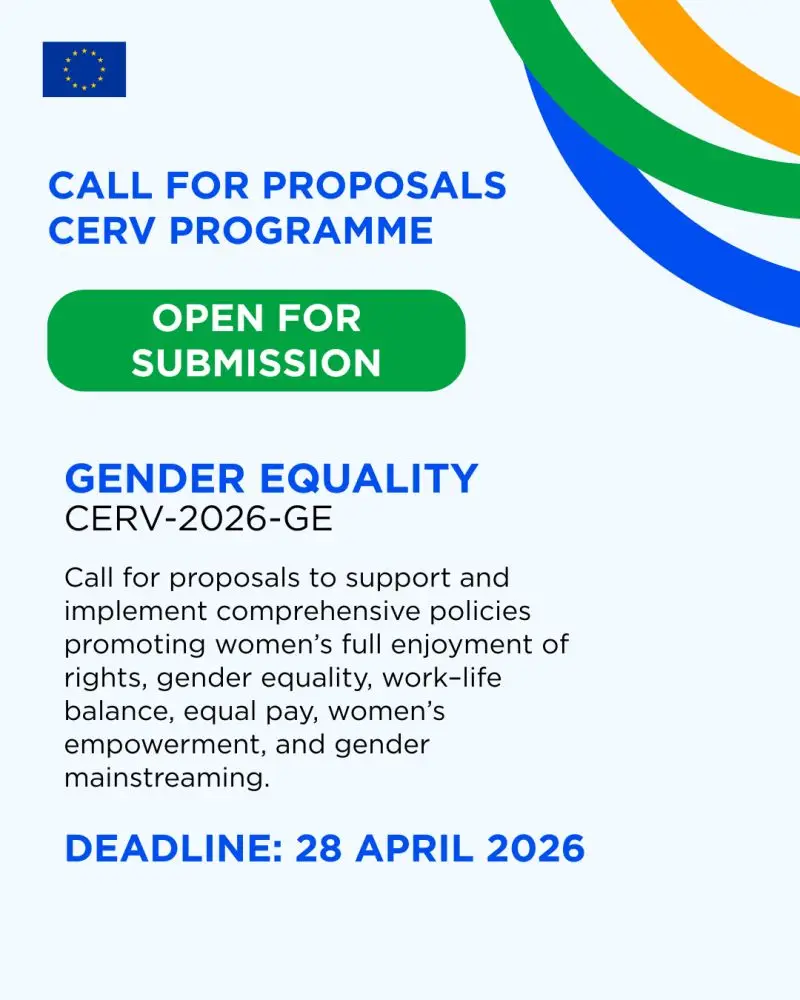
The CERV-2026-GE Call for Proposals to Promote Gender Equality is a fully funded EU grant opportunitylaunched by the European Commission under the Citizens, Equality, Rights and Values (CERV) Programme. This call invites public authorities, civil society organisations, equality bodies, social partners, labour inspectorates, and other eligible stakeholders to submit project proposals aimed at advancing gender equality, addressing structural discrimination, and strengthening the equal participation of women and men across economic, political, and social life.
The CERV-2026-GE Call for Proposals supports national and transnational initiatives that align with EU gender equality legislation, including the Work-Life Balance Directive, the Pay Transparency Directive (EU) 2023/970, and the Women on Boards Directive (EU) 2022/2381. With a total estimated budget of EUR 23 million, this EU-funded gender equality grant provides substantial financial support for impactful, policy-relevant, and action-oriented projects.
Background and Objectives of the CERV-2026-GE Gender Equality Call
The CERV-2026-GE Call for Proposals to Promote Gender Equality is rooted in the EU Gender Equality Strategy 2020–2025, the EU Roadmap for Women’s Rights, and the European Union’s commitment to upholding fundamental rights, equality, and non-discrimination as enshrined in Article 2 of the Treaty on the European Union and Article 21 of the EU Charter of Fundamental Rights.
Despite progress in recent decades, gender inequalities persist across the European Union, particularly in areas such as unpaid care work, pay gaps, access to leadership positions, and gender stereotypes reinforced through media and advertising. The European Commission recognises that these challenges require coordinated, multi-level, and evidence-informed interventions, involving governments, employers, social partners, civil society, and the media.
The CERV-2026-GE Call for Proposals seeks to:
-
Promote equal rights and opportunities for women and men
-
Address structural and systemic gender inequalities
-
Support the implementation of EU gender equality legislation
-
Encourage gender mainstreaming across policies, institutions, and practices
-
Strengthen cooperation between stakeholders at national, regional, and EU levels
Projects funded under this call are expected to deliver tangible, sustainable outcomes, rather than focusing solely on research or theoretical analysis.
Themes and Priorities of the CERV-2026-GE Call for Proposals
Applicants must submit proposals under one of four thematic priorities defined by the European Commission. Each priority addresses a distinct but interconnected dimension of gender equality.
Priority 1: Supporting Work-Life Balance, Equal Sharing of Care Responsibilities, and the Value of Care Sector Jobs
Indicative budget: EUR 7 million
This priority responds to the persistent gender gap in unpaid care work and the structural undervaluation of care sector jobs, which are predominantly performed by women. It aligns with the European Care Strategy, the Council Recommendation on Early Childhood Education and Care (Barcelona targets for 2030), and the Work-Life Balance Directive.
Objectives of Priority 1
Projects under this priority aim to:
-
Promote family-friendly workplace practices
-
Encourage the equal sharing of care responsibilities between women and men
-
Prevent discrimination related to pregnancy, family leave, or flexible work arrangements
-
Improve recognition and working conditions in formal care professions
Eligible Activities under Priority 1
Funded activities may include:
-
Capacity building and training for employers, particularly HR managers, on family-friendly working arrangements, flexible work, telework, hybrid work, job sharing, and shorter working weeks
-
Awareness-raising on rights under the Work-Life Balance Directive
-
Training and support programmes targeted at men to promote active involvement in parenting and long-term care
-
Initiatives to attract boys and men into care-related education, training, and employment
-
Activities addressing horizontal gender segregation in childcare and long-term care sectors
Projects are expected to promote gender equality mainstreaming, avoid reinforcing stereotypes, and ensure balanced participation across genders.
Priority 2: Promoting and Supporting the Implementation of the Pay Transparency Directive and Equal Pay
Indicative budget: EUR 5 million
This priority supports the implementation of Directive (EU) 2023/970, which establishes concrete obligations for employers regarding pay transparency and equal pay for equal work or work of equal value.
Objectives of Priority 2
Projects should:
-
Strengthen compliance with EU pay transparency obligations
-
Improve employer capacity to report gender pay gaps
-
Promote non-discriminatory pay structures
-
Support social dialogue on equal pay
Eligible Activities under Priority 2
Eligible activities include:
-
Development of digital tools for pay gap reporting in line with Article 9 of the Directive
-
Technical assistance and training for employers on pay reporting and joint pay assessments
-
Support for employers with fewer than 250 workers
-
Capacity building for social partners on gender-neutral job evaluation systems
-
Awareness-raising campaigns on the benefits of pay transparency and equal pay
Applicants must clearly explain how their project aligns with the Pay Transparency Directive and supports national transposition and implementation. Engagement with relevant public authorities is strongly encouraged.
Priority 3: Supporting Equal Participation and Representation in Economic and Political Decision-Making
Indicative budget: EUR 6 million
Women remain underrepresented in political leadership and corporate decision-making roles across EU Member States. This priority supports initiatives aligned with the Women on Boards Directive (EU) 2022/2381 and the Gender Equality Strategy 2020–2025.
Objectives of Priority 3
Projects aim to:
-
Increase women’s participation in political and economic leadership
-
Strengthen women’s leadership capacities
-
Address structural and societal barriers to representation
Eligible Activities under Priority 3
Activities may include:
-
Development and implementation of national strategies for gender balance in politics
-
Mentoring, coaching, networking, and training for women political candidates and elected representatives
-
Training on unconscious gender bias for political leaders
-
Promotion of gender-sensitive, inclusive, and family-friendly political institutions
-
Development of tools and guidance for objective, merit-based board member selection in line with Directive 2022/2381
Projects supporting individual political parties are not eligible for funding.
Priority 4: Tackling Gender Stereotypes in Media and Advertising
Indicative budget: EUR 5 million
This priority addresses the role of media and advertising in shaping societal norms and reinforcing gender stereotypes.
Objectives of Priority 4
Projects should:
-
Challenge conscious and unconscious gender bias
-
Promote non-stereotypical representation of women and men
-
Build capacity among media and advertising professionals
Eligible Activities under Priority 4
Eligible activities include:
-
Training for journalists, advertisers, scriptwriters, and media professionals
-
Development of codes of conduct and professional guidelines
-
Awareness-raising campaigns
-
Gender-sensitive awards or labels for media and advertising organisations
Projects involving media outlets and advertising self-regulatory bodies will be given preference.
Available Budget and Grant Size
-
Total estimated call budget: EUR 23,000,000
-
Minimum grant per project: EUR 100,000
-
Maximum grant per project: EUR 500,000
The European Commission reserves the right to redistribute funds across priorities or not award the full budget.
Project Duration and Geographic Scope
-
Project duration: 12 to 24 months
-
Geographic scope:
-
EU Member States (including overseas countries and territories)
-
Non-EU countries associated with the CERV Programme or with ongoing association negotiations
-
Projects may be national or transnational, with transnational cooperation strongly encouraged.
Eligibility Criteria: Who Can Apply?
Eligible Applicants
Applicants must:
-
Be legal entities (public or private)
-
Be established in eligible countries
-
Conduct activities in eligible countries
Profit-oriented organisations may apply only in partnership with public entities or private non-profit organisations.
Consortium Requirements
-
Proposals must be submitted by a consortium of at least two beneficiaries
-
The lead applicant (Coordinator) may submit only one proposal
-
Natural persons are not eligible (except self-employed sole traders)
-
EU bodies (except the Joint Research Centre) are not eligible
Application Process: How to Apply
Applications must be submitted electronically via the EU Funding & Tenders Portal.
Required Documents
-
Application Form Part A (administrative and budget information)
-
Application Form Part B (technical description, max. 45 pages)
-
KPI tool
-
Mandatory annexes, including:
-
Detailed budget table
-
CVs of core team members
-
Activity report of the coordinator
-
List of previous projects
-
Declaration of single coordinator participation
-
Child protection policy (where applicable)
-
Paper applications are not accepted.
Important Dates and Deadline
-
Call opening: 29 January 2026
-
Application deadline: 28 April 2026 at 17:00 CET (Brussels time)
-
Evaluation period: April – October 2026
-
Results notification: October 2026
-
Grant agreement signature: November 2026 – February 2027
Apply via the EU Funding and Tenders Portal
Why Apply for the CERV-2026-GE Gender Equality Grant?
The CERV-2026-GE Call for Proposals to Promote Gender Equality provides a strategic funding opportunity for organisations committed to gender equality, equal pay, inclusive leadership, and non-discriminatory representationacross Europe. With strong policy backing, flexible project design, and substantial EU funding, this call enables stakeholders to deliver sustainable, systemic change that advances equality and strengthens democratic values.
For more opportunities visit Opportunities for youth