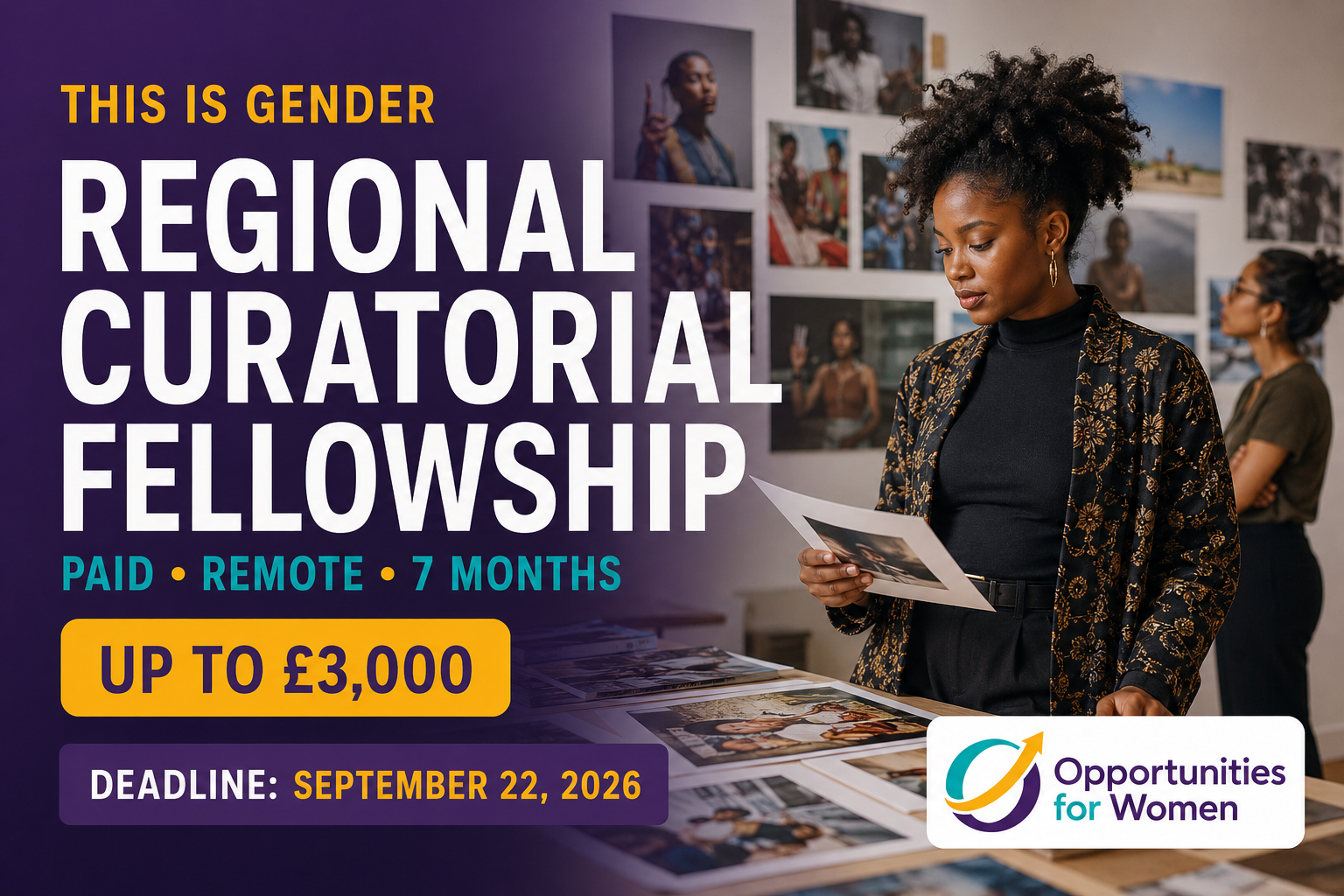
This Is Gender Regional Curatorial Fellowship 2026 Your regional knowledge to help change how gender is represented through photography worldwide.
Applications are open for the inaugural This Is Gender Regional Curatorial Fellowship 2026, a paid, remote opportunity for emerging curators and cultural practitioners interested in photography, visual storytelling, representation and gender justice.
The seven-month programme will place regional fellows inside This Is Gender’s global photography competition. Fellows will help review submissions, influence curatorial decisions and contribute to exhibitions, publications and digital storytelling projects.
The fellowship is flexible and part-time, requiring approximately one day of work per week. Selected fellows will receive a stipend of up to £3,000.
Applications close on September 22, 2026.
About This Is Gender
This Is Gender is Global 50/50’s international visual-storytelling initiative. It uses photography to examine how gender shapes people’s identities, opportunities, choices, rights and experiences.
Over six competition cycles, the platform has received thousands of submissions from photographers and visual practitioners worldwide. Selected images have appeared in exhibitions, publications, media platforms, advocacy campaigns and research addressing gender justice.
However, the people and institutions deciding which photographs receive attention do not always represent the communities depicted in those images.
The Regional Curatorial Fellows Programme was created to address that imbalance by bringing regional knowledge, cultural understanding and lived experience into the selection and interpretation process. Read the official programme announcement.
What is the Regional Curatorial Fellowship?
This is a seven-month professional-development programme for early-career practitioners working across visual culture, photography, research, storytelling and community-based cultural work.
Fellows will join an international cohort and work alongside the This Is Gender team, international judges, artists, curators, editors and other cultural practitioners.
Rather than observing the competition from the outside, fellows will participate in different stages of its development—from regional outreach and submission reviews to selection, interpretation and public presentation.
The programme is expected to begin in late 2026 and will operate remotely.
Fellowship benefits
Selected fellows will receive:
- A stipend of up to £3,000
- Seven months of practical curatorial experience
- Direct involvement in a global photography competition
- Experience reviewing a large international submission pool
- Opportunities to influence image-selection decisions
- Professional engagement with international judges and curators
- Experience contributing to exhibitions and publications
- Opportunities to strengthen their curatorial writing
- Access to an international network of cultural practitioners
- Greater visibility for their regional perspectives and expertise
The fellowship offers learning through practical involvement, discussion and collaboration rather than through a traditional academic course.
What will fellows do?
Regional Curatorial Fellows will contribute across four main areas.
Regional outreach
Fellows will help position and communicate the photography competition within their respective regions.
They may connect This Is Gender with photographers, community organisations, cultural networks and institutions that are often overlooked by established international photography platforms.
The objective is to create new pathways for underrepresented artists and visual practitioners to participate.
Image selection and interpretation
Fellows will review submissions and participate in discussions about which images should be selected and promoted.
They will bring culturally grounded perspectives to how photographs are understood, ensuring that images are not interpreted without sufficient awareness of their regional, political and social contexts.
Exhibitions and public outputs
Fellows will help shape how selected images are grouped, framed and presented through:
- Exhibitions
- Digital platforms
- Publications
- Editorial writing
- Interviews
- Storytelling projects
- Social-media activities
- Global 50/50 reports and campaigns
They may also have opportunities to develop their own public-facing curatorial contributions.
Collaboration and professional development
Participants will work with an international cohort of emerging curators and engage with established practitioners across visual arts, journalism, research and cultural programming.
This exposure will help fellows strengthen their professional networks and better understand how global photography platforms make decisions and develop public programmes.
Who can apply?
Applications are welcomed from:
- Curators
- Critics
- Writers
- Researchers
- Artistic directors
- Photographers
- Editors
- Cultural organisers
- Storytellers
- Community practitioners
- People working in socially engaged creative practice
The opportunity primarily seeks people from global-majority countries and historically underrepresented communities, including practitioners connected to:
- Africa
- Asia
- Latin America
- The Middle East
- Oceania
- Diasporic communities worldwide
There are no strict geographical restrictions. Applicants must, however, demonstrate meaningful knowledge of and engagement with the communities or cultural contexts their practice represents. Diaspora applicants may apply even if they currently live outside their region of connection. Review the official fellowship information.
Do applicants need to be professional curators?
No formal curatorial title is required.
This Is Gender is particularly interested in emerging practitioners, recent graduates and people in the early stages of developing their practice.
Relevant experience may come from:
- Photography
- Visual research
- Independent creative projects
- Editorial work
- Cultural organising
- Community initiatives
- Curatorial writing
- Grassroots arts programming
- Research
- Socially engaged practice
Applicants do not need previous professional experience specifically focused on gender. However, they should demonstrate a genuine interest in gender, power, justice and representation.
Language and accessibility
The fellowship will operate primarily in English, but applicants whose first language is not English are welcome.
The organizers recognize the value of different languages, perspectives and working methods. Some live meetings will be required, with sessions scheduled as fairly as possible across different time zones.
Disabled practitioners and applicants with accessibility requirements are actively encouraged to apply. Alternative application formats or reasonable adjustments may be requested from the programme team.
Time commitment
The fellowship is:
- Fully remote
- Part-time and flexible
- Approximately one day per week
- Seven months in duration
- Expected to begin in October or late 2026
Certain stages—including outreach, submission review and final selection—may require more time.
Applicants may participate while working full-time, studying or managing a freelance practice, provided they can contribute consistently and attend required meetings.
What does the application require?
Candidates must complete a short online application form containing:
- Personal and contact information
- Current location and regional connections
- Professional or creative background
- Languages and proficiency levels
- Availability during the fellowship period
- Links to relevant work or projects
- Responses to several short questions
Applicants will be asked to discuss:
- Why they are interested in the fellowship
- Their experience with photography or visual culture
- The regional visual landscape in which they work
- How gender, power and representation are addressed in that context
- How they would conduct outreach for a global photography competition
- An image or creative project that influenced their understanding of representation
A full portfolio is not required. Applicants may provide a small number of relevant links to published writing, research, photography, exhibitions, community projects, social-media accounts or other examples of their practice.
Selection process
Applications will be evaluated based on:
- Regional and contextual knowledge
- Engagement with photography or visual culture
- Critical perspective
- Connection to relevant cultural networks
- Outreach potential
- Ability to contribute to a collaborative curatorial process
- Alignment with the fellowship’s commitment to visual and gender justice
Shortlisted applicants may be invited to an online interview. The organizers expect to contact applicants approximately one week after applications close. Consult the official fellowship FAQs.
How to apply
- Read the complete fellowship description.
- Review the eligibility and frequently asked questions.
- Gather links to relevant projects or examples of your work.
- Prepare concise responses to the application questions.
- Complete the online form.
- Save a copy of your responses.
- Submit by September 22, 2026.
👉 Complete the official application form.
Opportunities for Women is not the fellowship provider. Applicants should confirm all information through the official programme pages before applying.