
Program Overview
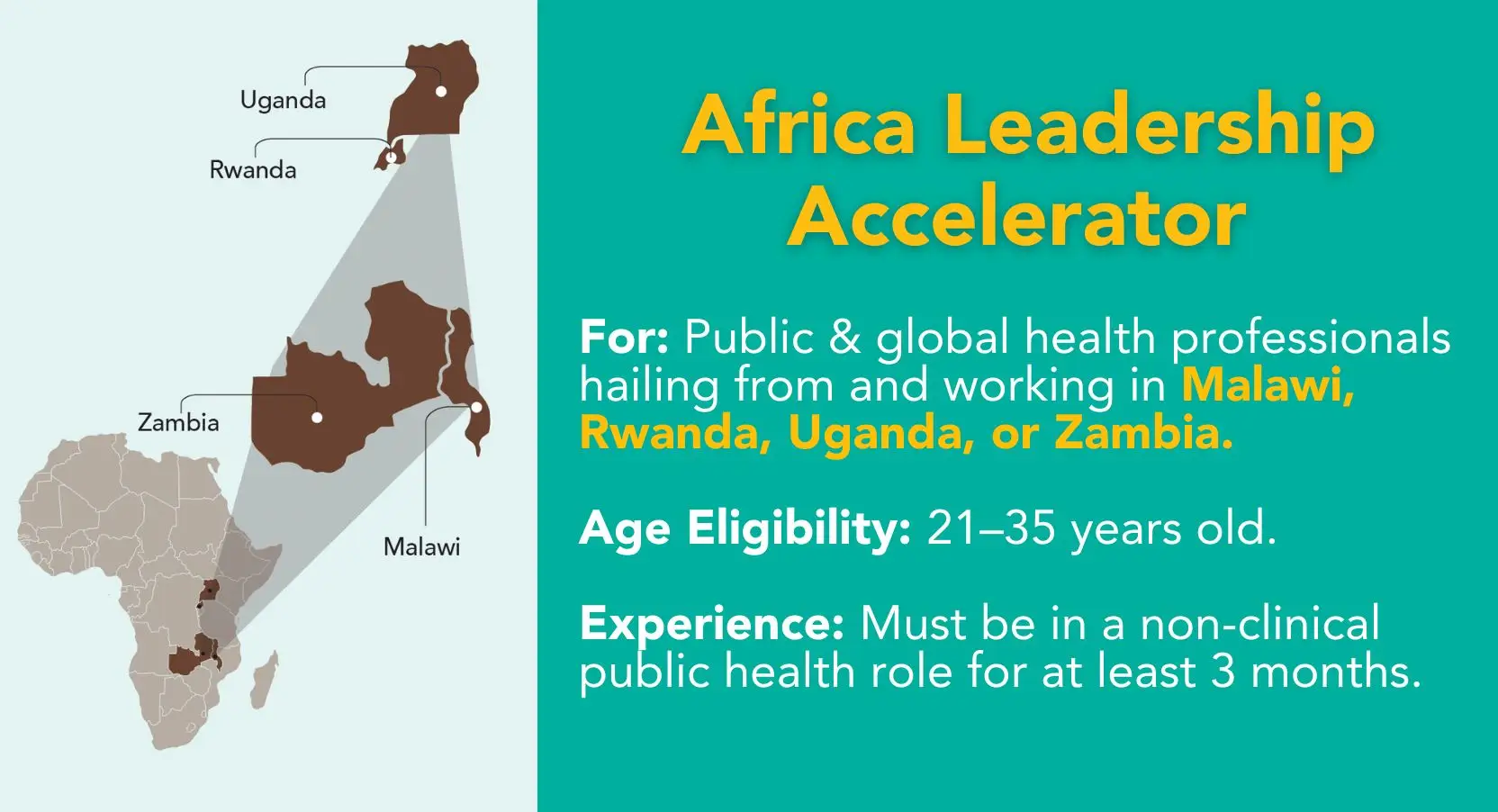
Applications are now open for the Africa Leadership Accelerator (ALA) 2026–2027 Cohort, a fully funded 9-month hybrid fellowship designed for early- to mid-career public health professionals working across Malawi, Rwanda, Uganda, and Zambia.
Priority applications are due by March 5, 2026, and the final deadline is March 19, 2026. The fellowship runs from September 2026 through May 2027.
Delivered by Global Health Corps, the Africa Leadership Accelerator strengthens leadership capacity, deepens systems thinking, and integrates fellows into a powerful global network of health equity leaders — all while they remain in their current full-time roles.
The Africa Leadership Accelerator is a structured leadership development fellowship tailored for professionals already working in non-clinical public health roles. Through a carefully designed hybrid learning model, fellows engage in:
-
Monthly virtual leadership workshops
-
Small group peer learning
-
Individual coaching and 360° feedback
-
In-person retreats
-
Ongoing mentorship
-
Integration into a lifelong alumni network
The goal is to strengthen participants’ ability to lead within their institutions and advance health equity across their communities and ecosystems.
Why the Africa Leadership Accelerator Matters
Addressing the Public Health Leadership Skills Gap
Across Sub-Saharan Africa, emerging public health professionals are deeply committed to improving health systems. However, traditional academic pathways and on-the-job training often fall short in equipping them with essential leadership and management competencies.
Critical skills such as:
-
Adaptive leadership
-
Strategic decision-making
-
Cross-sector collaboration
-
Systems navigation
-
Trust building and feedback
-
Managing change
are rarely developed intentionally. The Africa Leadership Accelerator directly addresses these gaps through structured training, reflection, and applied learning.
Combating Burnout and Strengthening Resilience
Public health workers across the region are navigating increasing workloads amid funding cuts and systemic pressures. Many are asked to do more with fewer resources.
The fellowship provides:
-
Coaching and mentorship
-
A supportive peer network
-
Structured reflection spaces
-
Professional growth opportunities
These elements are designed to bolster resilience and help leaders sustain long-term impact in challenging environments.
Promoting Representation and Inclusion
Emerging professionals from underrepresented backgrounds — including women and leaders from low- and middle-income settings — frequently face systemic barriers to advancement.
The Africa Leadership Accelerator intentionally cultivates a leadership experience grounded in inclusivity, belonging, and equity. The program supports fellows in strengthening their voice, identity, and influence within global and local public health spaces.
The Organizational Case for Leadership Development
Investing in leadership development benefits not only individuals but also their institutions.
Data from past cohorts shows measurable impact:
-
73% of fellows took on expanded leadership responsibilities
-
93% reported that the program contributed directly to their professional achievements
-
98% stated that engagement in the program improved their work outcomes
Fellows often expand their scope of work to include:
-
Management of people, projects, and programs
-
Technical advisory contributions
-
Data management and modeling
-
Strategic planning and stakeholder engagement
-
Recruitment, grant writing, and budget development
Throughout the fellowship, participants collaborate with supervisors and GHC staff to design stretch projects that directly benefit their organizations.
Employers are invited to contribute toward program costs based on context and capacity. This contribution does not influence applicant selection and must not become a barrier to participation.
What Fellows Gain
Strengthened Leadership Identity
Participants clarify their personal values, leadership strengths, and professional vision while developing a deeper commitment to advancing health equity.
Expanded Strategic Networks
Fellows join a lifelong global network of over 1,300 alumni across more than 40 countries, creating lasting professional connections and collaborative opportunities.
Enhanced Systems Thinking
The program introduces practical tools and frameworks for analyzing complex health systems, identifying leverage points, and designing sustainable change strategies.
Immediate Application of Learning
Because fellows remain in their current roles, they apply learning directly to real-world challenges, creating tangible impact during the program.
Fellowship Structure
The Africa Leadership Accelerator follows a hybrid format with mandatory participation in core components.
Learning
-
Monthly 3-hour virtual Leadership Academy workshops
-
Monthly small group learning sessions (1–2 hours)
-
Asynchronous preparation work (1–2 hours per month)
-
Optional webinars and networking opportunities
Coaching and Mentorship
-
360-degree assessment
-
One-on-one coaching with GHC staff
-
Alumni and partner mentorship
In-Person Retreats
Two multi-day, overnight retreats are included. Travel, accommodation, and most meals are fully covered.
Key Dates
-
February 16, 2026: Applications Open
-
March 5, 2026: Priority Deadline
-
March 19, 2026: Final Deadline
-
August 2026: All applicants notified
-
September 2026: Fellowship launch
-
January 2027: Mid-fellowship in-person retreat
-
May 2027: Program completion and transition to alumni community
Who Should Apply?
The fellowship is designed for high-potential early-career public health leaders working in non-clinical roles such as:
-
Policy and advocacy
-
Program design and implementation
-
Research and data analysis
-
Systems strengthening
-
Communications and community engagement
-
Grant management and partnerships
-
Youth and community health programming
Past fellows have held roles in ministries of health, international NGOs, UN agencies, and national public health institutions.
Apply here:
https://ghcorps.submittable.com/submit/349112/ala-cohort-3-application-2026-2027/eligibility
Eligibility Requirements
Applicants must:
-
Be 21–35 years old by September 1, 2026
-
Be a citizen of Malawi, Rwanda, Uganda, or Zambia
-
Be employed full-time in a non-clinical public health role
-
Have worked at their current organization for at least three months
-
Be employed by an organization operating in one of the four eligible countries
-
Obtain written supervisor support
-
Be fluent in English
Clinical roles involving direct patient care (e.g., physicians, nurses, midwives) are not eligible.
There are no specific educational degree requirements.
Application Process
The application consists of multiple stages:
Part 1: Supervisor Recommendation
Applicants must submit their supervisor’s contact details. The supervisor must complete the recommendation before the remainder of the application becomes accessible.
Part 2: Full Application Submission
Applicants submit:
-
CV
-
Professional bio
-
Short essay responses
-
60-second video submission
-
References
-
Demographic information
Finalists will be interviewed in May and June 2026. All applicants will be notified of their status by July 31, 2026.
Apply here:
https://ghcorps.submittable.com/submit/349112/ala-cohort-3-application-2026-2027/eligibility
For questions, contact: applyinfo@ghcorps.org
Frequently Asked Questions (FAQs) – Africa Leadership Accelerator 2026–2027
Below are answers to some of the most common questions about the Africa Leadership Accelerator Fellowship.
For the complete and official FAQ page, visit:
https://ghcorps.org/africa-leadership-accelerator-fellowship-faqs/
What are the eligibility requirements for the Africa Leadership Accelerator?
To apply, you must:
-
Be 21–35 years old by September 1, 2026
-
Be a citizen of Malawi, Rwanda, Uganda, or Zambia
-
Be employed full-time in a non-clinical public health role
-
Have worked at your current organization for at least three months
-
Be employed by a public health organization operating in one of the four eligible countries
-
Have written supervisor support
-
Be fluent in English
There are no specific educational degree requirements.
Can I remain in my current job while participating in the fellowship?
Yes. The fellowship is designed to run alongside your full-time role. Fellows stay in their current positions and apply learning directly to ongoing work projects.
Are fellows required to remain at their organization for the full duration of the program?
Yes. Fellows are expected to remain with their organization throughout the 9-month program. If you anticipate leaving your organization within the next year, you are encouraged to apply in a future cycle.
Unexpected transitions are assessed on a case-by-case basis.
What does “non-clinical” mean?
Non-clinical roles refer to public health positions that do not involve providing direct medical care to patients.
Eligible roles include:
-
Policy and advocacy
-
Program design and implementation
-
Research and data analysis
-
Systems strengthening
-
Communications
-
Management and administration
Clinical roles such as physicians, nurses, midwives, and other positions responsible for diagnosis or treatment are not eligible.
Is there tuition or a program fee?
No. There is no tuition.
Travel, lodging, and most meals for in-person retreats are fully covered by Global Health Corps.
Employers may be invited to contribute toward costs based on their capacity, but this does not affect applicant selection and must not be a barrier to participation.
How large is each cohort?
Cohorts typically consist of 30–50 fellows. Participants are also placed into small peer groups (3–5 fellows) to deepen learning and collaboration.
What is the time commitment?
In addition to monthly workshops, fellows should expect:
-
1–2 hours of preparation per month
-
1 hour of small group learning monthly
-
3–5 hours of coaching and professional development monthly
Attendance at all workshops and retreats is mandatory unless otherwise arranged in advance.
Can I defer my acceptance to a future cohort?
No. Deferrals are not permitted. Applicants who remain eligible are welcome to reapply in future cycles.
When will applicants be notified?
All applicants will be notified of their status by July 31, 2026. Finalist interviews will take place in May and June 2026.
For additional details and expanded responses, visit the official FAQ page:
https://ghcorps.org/africa-leadership-accelerator-fellowship-faqs/
Conclusion
The Africa Leadership Accelerator is more than a fellowship. It is a structured, equity-centered leadership development experience designed to strengthen the next generation of public health changemakers in Malawi, Rwanda, Uganda, and Zambia.
For professionals committed to advancing health equity, strengthening institutions, and leading systemic change, this fellowship offers the tools, mentorship, and global network necessary to accelerate long-term impact.
Applications close March 19, 2026, with priority consideration for submissions received by March 5, 2026. Find out more from here https://ghcorps.org/africa-leadership-accelerator-overview/