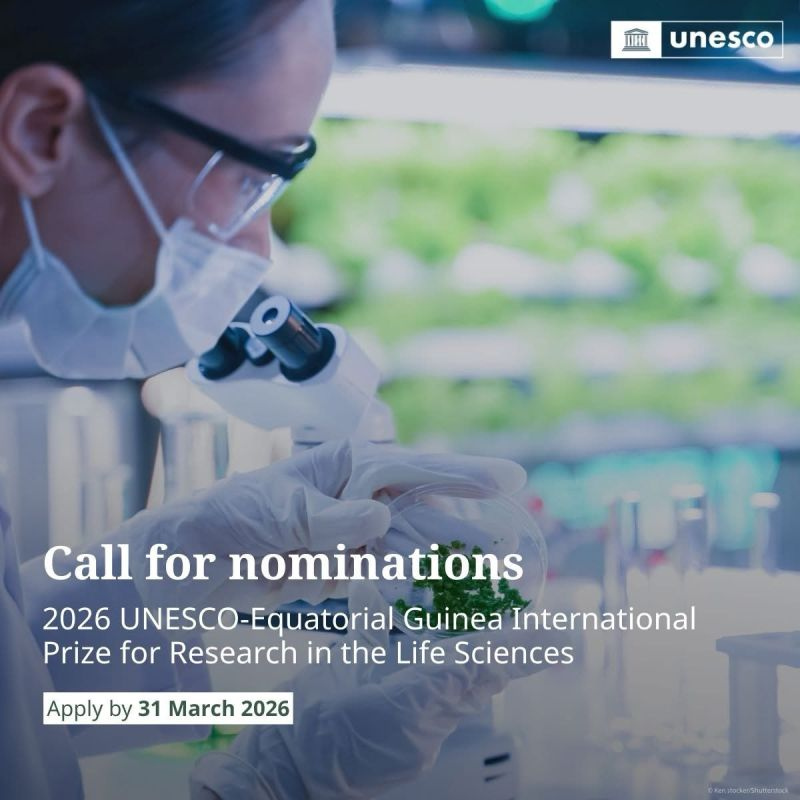
The UNESCO–Equatorial Guinea International Prize for Research in the Life Sciences has officially opened its tenth edition call for nominations. This prestigious award recognizes individuals, groups, institutions, and non-governmental organizations whose research and projects have made outstanding contributions to the improvement of human life.
Established in 2008 by UNESCO’s Executive Board, the Prize plays a vital role in advancing scientific knowledge and strengthening capacities for sustainable development. It directly supports the 2030 Sustainable Development Goals (SDGs), particularly those focused on improving quality of life and ensuring inclusivity: SDG 1, 2, 5, 8, and 10.
About the Prize
- Purpose: To reward excellence in life sciences research that contributes to human well-being.
- Funding: Sponsored by the Republic of Equatorial Guinea.
- Monetary Value: USD $300,000, shared equally among up to three laureates.
- Additional Recognition: Laureates receive a certificate and the Integración Tribal statuette, created by Equatorial Guinean artist Leandro Mbomio.
This Prize is not only financial recognition but also a symbolic acknowledgment of the role of science in fostering a better, more equitable world.
Eligibility Criteria
Applications can only be submitted by designated authorities. Eligible nominators include:
- UNESCO Member States through their National Commissions.
- Non-governmental organizations (NGOs) in official partnership with UNESCO, active in relevant fields covered by the Prize.
Important Notes:
- Each Member State or NGO may submit up to five nominations.
- Self-nominations are not accepted.
- Incomplete applications will not be considered.
Application Submission Process
Applications must follow a structured process to ensure fairness and transparency:
- Invitation by Designating Authorities
- National Commissions or NGOs invite candidates they wish to endorse.
- Candidate Submission
- Candidates submit their applications to the National Commission via the online platform.
- Only officially endorsed applications are received by the UNESCO Secretariat.
- Application Form Requirements
- Must be completed in English or French.
- Should include:
- Background information
- Outline of the candidate’s contribution to the Prize’s objectives
- Summary of research work
- List of major scientific publications
Key Dates
- Deadline for Applications: 31 March 2026
- Prize Edition: Tenth edition (2026)
Why This Prize Matters
The UNESCO–Equatorial Guinea International Prize for Research in the Life Sciences is more than an award—it is a catalyst for global progress. By recognizing groundbreaking research, it:
- Encourages innovation in life sciences.
- Strengthens international collaboration.
- Promotes sustainable development aligned with the SDGs.
- Ensures that scientific advancements contribute to better lives for all, without leaving anyone behind.
Related UNESCO Initiatives
This Prize is part of UNESCO’s broader commitment to science and innovation. Recent initiatives include:
- UNESCO Chair on Digital Technologies and Human Behavior (launched February 2026).
- WISE Initiative supporting women scientists (January 2026).
- Efforts to strengthen water security in Tabasco, Mexico (January 2026).
- Guidance for Lao PDR’s National AI Strategy (January 2026).
These initiatives highlight UNESCO’s dedication to addressing global challenges such as climate change, biodiversity, and digital transformation.
The 2026 call for applications for the UNESCO–Equatorial Guinea International Prize for Research in the Life Sciences is a unique opportunity for researchers and institutions worldwide to gain recognition for their contributions to human well-being. With a substantial monetary award, symbolic recognition, and alignment with the SDGs, this Prize stands as a beacon of scientific excellence and social impact. Learn more and apply here.