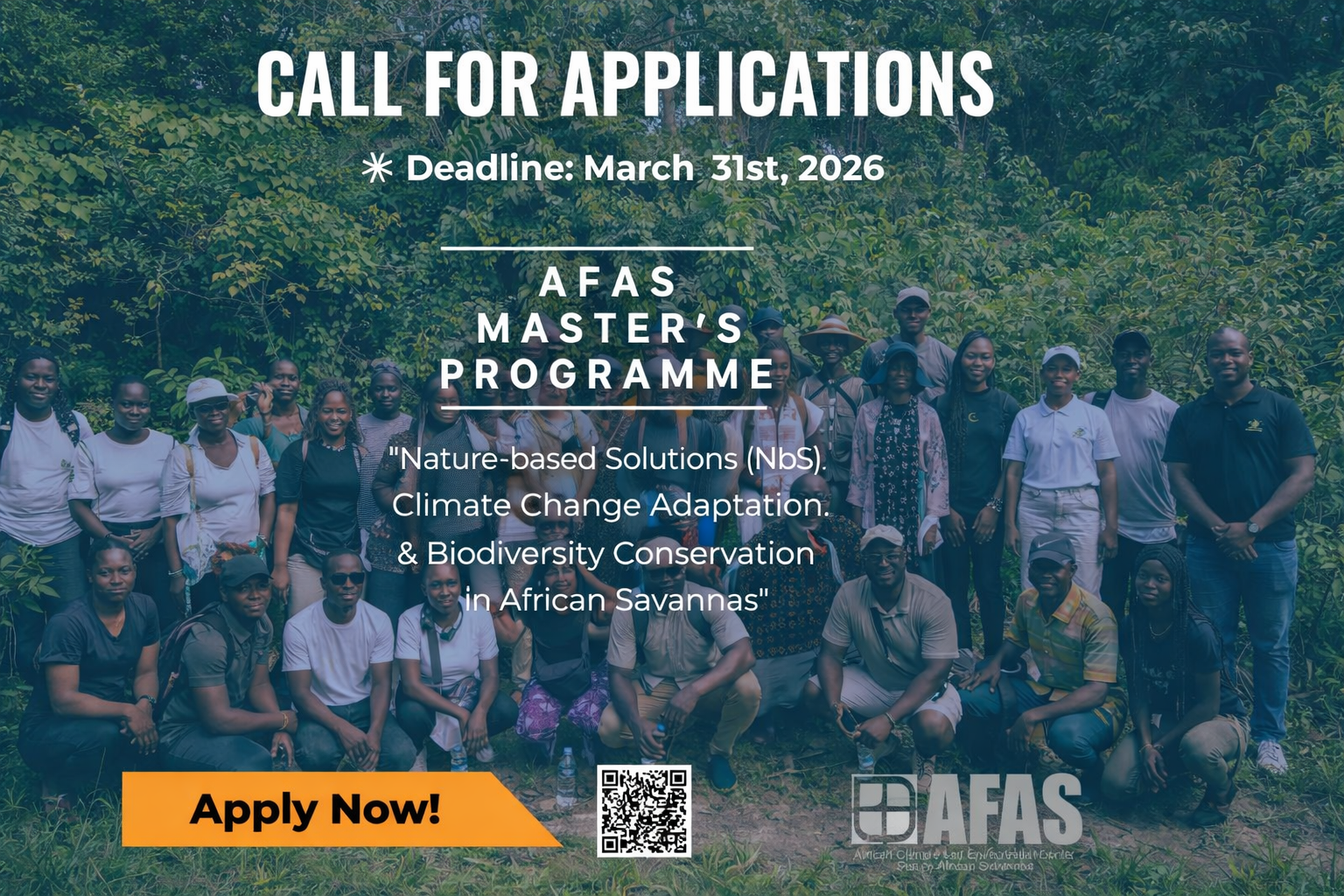
Applications are now open for the AFAS Master’s Fellowships 2026 intake, offering fully funded opportunities for young African scholars to pursue advanced studies focused on Nature-based Solutions (NbS), climate change adaptation, and biodiversity conservation across African savanna landscapes.
This highly competitive programme is designed for motivated graduates who want to bridge science, policy, and practice and contribute to real-world environmental solutions across Africa.
- Application deadline: 31st March 2026
- Applicants may apply to either the University of Nairobi (UoN), Nairobi, Kenya, or Université Félix Houphouët-Boigny (UFHB), Abidjan, Côte d’Ivoire, BUT NOT BOTH
- There is a simultaneous call for master fellowships at CABES, a project closely linked to AFAS. Applicants can only apply to either the CABES or AFAS master programme BUT NOT BOTH
About the AFAS Master’s Programme
The African Climate and Environment Centre – Future African Savannas (AFAS) is a part of the Global Centers for Climate and Environment program of the German Academic Exchange Service (DAAD). AFAS is a partnership of four universities: the University of Nairobi (UoN), Université Félix Houphouët-Boigny (UFHB), the University of Cologne, and the University of Bonn. The program is based at the University of Nairobi through its Institute for Climate Change and Adaptation (ICCA) in Nairobi, Kenya, and at the Université Félix Houphouët-Boigny through its African Centre of Excellence on Climate Change, Biodiversity and Sustainable Agriculture (CEA-CCBAD) in Abidjan, Côte d’Ivoire.
The African Climate and Environment Centre – Future African Savannas (AFAS) is part of the DAAD Global Centers for Climate and Environment Programme. AFAS brings together a consortium of leading institutions:
-
University of Nairobi (Kenya)
-
Université Félix Houphouët-Boigny (Côte d’Ivoire)
-
University of Cologne (Germany)
-
University of Bonn (Germany)
The programme is hosted at:
-
Institute for Climate Change and Adaptation (ICCA) – University of Nairobi
-
African Centre of Excellence on Climate Change, Biodiversity and Sustainable Agriculture (CEA-CCBAD) – UFHB
AFAS trains graduates to connect research with policy and practice while engaging directly with stakeholders, communities, NGOs, and decision-makers.
Programme Focus Areas
AFAS Phase 2 (2026–2030) builds on earlier success and emphasizes implementation, stakeholder engagement, and real-world impact. The programme focuses on:
-
Nature-based Solutions (NbS)
-
Science–Policy–Practice Interface (SPPI)
-
Climate change adaptation
-
Ecosystem conservation in African savannas
For their Master’s thesis, fellows will select one primary thematic area:
-
Water
-
Agriculture
-
Energy
-
One Health
-
Biodiversity
Applicants must explain their thematic preference in their motivation and reflection statement.
Fellowship Overview (2026 Intake)
AFAS will award 18 fully funded Master’s fellowships across its two host universities.
Selected fellows will:
-
Enroll in an AFAS-aligned Master’s programme
-
Participate in joint courses and hybrid modules
-
Receive soft-skills training
-
Conduct demand-oriented research on Nature-based Solutions
-
Engage with policy actors and practitioners
-
Complete a Master’s thesis linked to real-world challenges
Language of instruction: English
What the Fellowship Covers
The AFAS fellowship provides comprehensive support, including:
-
Full tuition fees
-
Monthly stipend (local currency equivalent)
-
Health insurance
-
Laptop computer
-
Individual research budget (after proposal approval)
-
Participation in summer schools, workshops, and exchange activities
Funding continuation depends on satisfactory academic progress and engagement.
Who Should Apply
This is not a conventional academic scholarship. AFAS seeks applicants who demonstrate:
-
Critical and independent thinking
-
Strong motivation and reflection
-
Ability to connect environmental challenges with practical solutions
-
Clear personal insight and contextual understanding
Applications that rely on generic or scripted responses may be disadvantaged.
Selection Process
Selection is competitive and conducted in multiple stages:
-
Eligibility screening
-
Qualitative review of motivation statements
-
Shortlisted interviews assessing reasoning and alignment with AFAS
-
Final selection (subject to admission at host university)
Host University Options
Applicants may apply to ONE host institution only.
1. University of Nairobi (UoN), Kenya
Candidates willing to apply must have:
- Concluded a Bachelor’s or equivalent degree in environmental and/or agricultural sciences or biology, ecology and climate sciences, economics, sociology, or any other relevant discipline.
- Must have a minimum second-upper honors degree or equivalent approved by Kenya’s Commission for University Education (CUE)
- Must not be older than 26 years on the 2nd of October 2026.
- Must be willing to be a single/individual resident in the student’s residence recommended by the University of Nairobi for the duration of the program.
- This is a fulltime assignment which requires physical presence and outside work is not permitted for the duration of the fellowship.
- Applicants from universities which do not use English as a language of instruction should provide evidence of English proficiency in the form of a certificate of IELTS or TOEFL or equivalent demonstrating a satisfactory level of competence.
- University Certified Diplomas/Bachelors/Masters certificates (if not in English, please provide official English translation from/or certified by the university). Note: In certain cases, further verification may be required from Kenya’s Commission for University Education (see below).
- Before applying for the scholarship, applicants are expected to visit the University of Nairobi website https://www.uonbi.ac.ke and the Department of Earth and Climate Sciences website http://earthclimatesciences.uonbi.ac.ke to confirm their eligibility for admission and get more details on the program, respectively.
- At UoN, selected candidates will immediately be required to seek admission to the University of Nairobi master’s program in Climate Change Adaptation through the University website https://application.uonbi.ac.ke/. An application fee (approximately USD 50) will be charged which is non-refundable.
- A passport is required for non-Kenyan citizens.
2. Université Félix Houphouët-Boigny (UFHB), Côte d’Ivoire
Eligibility Highlights:
- Concluded a Bachelor’s or equivalent degree in environmental and/or agricultural sciences or biology, ecology and climate sciences, economics, sociology, or any other relevant discipline.
- The required university degrees must have been awarded by a university or a higher education institution officially recognized by the African and Malagasy Council for Higher Education (CAMES).
- Must not be older than age 26 years on the 2nd of October 2026.
- Be willing to be a single/individual resident on the campus of “Pôle Scientifique et d’Innovation de l’UFHB” for the full duration of the program.
- This is a full-time assignment which requires physical presence and outside work is not permitted for the duration of the fellowship.
- UFHB applicants from Central and Western Africa are encouraged to apply.
- University Certified Diplomas/Bachelors/Masters certificates. All certified documents not issued in French must be accompanied by an official French translation.
- Applicants from French-language academic backgrounds are asked to provide official evidence of English language proficiency, in the form of an IELTS or TOEFL certificate or equivalent demonstrating a satisfactory level of competence.
- A passport is required for non-citizens of the Economic Community of West African States (ECOWAS).
Required Application Documents (Single PDF Submission)
Motivation & Reflection Statement (max. 1000 words, 1.5 space, 11 Calibri)
Applicants must respond explicitly to the following prompts:
-
-
- Which ONE of the five thematic areas would you like to do research on: water, agriculture, energy, One Health and biodiversity? Motivate your choice with a short research idea in max. 250 words?
- Which other ONE of the five thematic areas could also be of interest to you (one sentence; no motivation needed)?
- What concrete environmental or development challenge motivates you personally?
- How do you understand Nature‑based Solutions in your own context?
- Describe one real example (project, policy, community practice, or observation) that shaped your interest.
- How do you see yourself engaging with policy or practice actors, not only actors from academia?
- What skills or perspectives do you hope to develop during AFAS Phase 2?
- Curriculum Vitae (max. 2 pages)
- University Certified Diplomas/Bachelors/Masters certificates (see details above).
- University Certified Transcripts of academic records (see details above).
- Two duly signed letters of recommendation, including the full contact details of the referees (at least one of the letters must be issued by a member of staff of the institution that awarded the most recent degree).
- Proof of English proficiency (if applicable)
- Birth certificate
- A recent passport photo
-
Motivation & Reflection Statement Prompts
Applicants must address:
-
Preferred thematic research area and short research idea (max. 250 words)
-
Secondary thematic interest
-
Personal environmental or development motivation
-
Understanding of Nature-based Solutions in context
-
Real-life example influencing interest
-
Engagement with policy or practice actors
-
Skills and perspectives to develop during AFAS Phase 2
Important Application Notes
-
Applicants may apply to either AFAS or CABES, not both.
-
Applicants may apply to either UoN or UFHB, not both.
-
Only shortlisted candidates will be contacted for interviews.
For technical questions, contact: info@afas.africa
Why This Opportunity Matters
The AFAS Master’s Fellowship is ideal for young professionals and graduates interested in:
-
Climate change adaptation in Africa
-
Biodiversity conservation
-
Nature-based Solutions research
-
Environmental policy and practice
-
Sustainable development careers
By combining academic excellence with practical engagement, AFAS prepares future leaders to address complex environmental challenges across African savannas.
How to Apply
Applications are open now for the 2026–2028 intake.
FOR MORE INFORMATION PLEASE CLICK HERE
Deadline: 31 March 2026
Interested applicants should prepare their documents early and submit a strong, reflective application demonstrating real-world understanding and motivation.