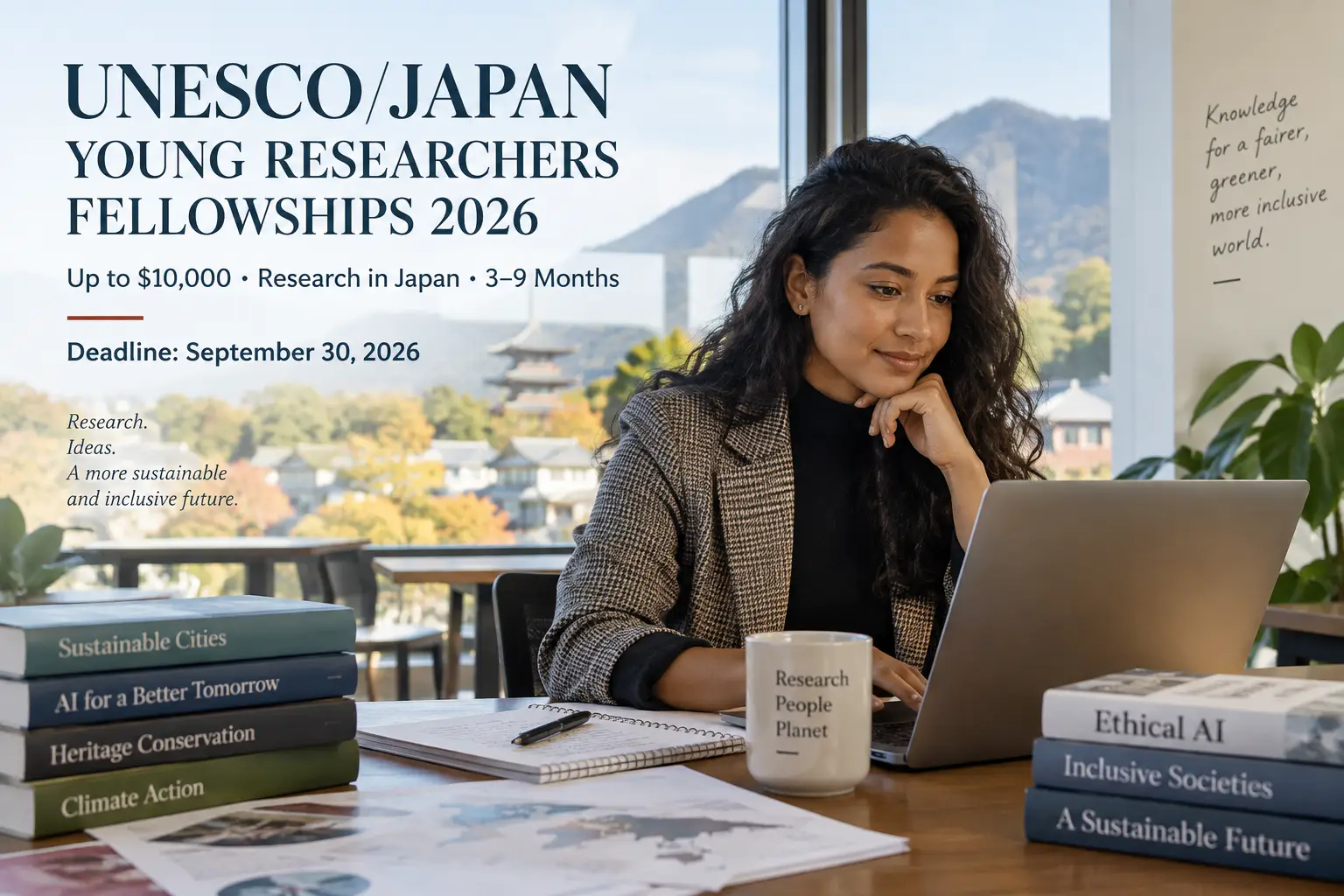
UNESCO/Japan Young Researchers’ Fellowships Programme 2026, an international research opportunity offering selected early-career researchers funding of up to US$10,000 to undertake postgraduate research at universities and research institutions in Japan. Also known as the UNESCO/Keizo Obuchi Research Fellowships Programme, the initiative is supported by the Government of Japan through the Japanese Funds-in-Trust for the Capacity-Building of Human Resources and administered by UNESCO. For the 2026 cycle, 10 fellowships will be awarded to highly qualified young researchers from eligible countries in Africa, Small Island Developing States, Ukraine and Türkiye. Research stays will take place in Japan from February 2027 onwards and must be completed no later than December 2027.
What Is the UNESCO/Japan Young Researchers Fellowship?
The programme was established in 2001 to strengthen research capacity and encourage international academic exchange in areas aligned with UNESCO’s mandate. Since its establishment, it has enabled 291 young researchers from 101 countries to pursue postgraduate research internationally. The 2026 cycle places particular emphasis on research connected to heritage conservation, sustainable development and artificial intelligence, including interdisciplinary work examining social, ethical, governance and contextual questions. Successful applicants conduct their research at a Japanese university or research institution under the supervision of an academic host.
How Much Funding Is Available?
Each selected fellow can receive a grant of up to US$10,000. The fellowship lasts for a minimum of three months and a maximum of nine months. The grant is provided as a lump-sum contribution toward the approved research stay.
Eligible costs can include:
- International and domestic travel
- Accommodation
- Medical insurance
- Meals and personal subsistence
- Local transportation
- Incidental expenses
and certain other directly related research expenses. Medical insurance is mandatory and will be arranged by UNESCO, with its cost deducted from the fellowship amount before disbursement. The fellowship does not ordinarily cover tuition fees, computers or other equipment, publication costs, or conference participation unless conference attendance is clearly justified as integral to the approved research.
Who Can Apply?
Applicants must be nationals of one of the countries or territories invited to participate in the 2026 cycle.
Candidates must also:
- Be 40 years old or younger at the time of application.
- Hold at least a master’s degree or equivalent in an area relevant to the proposed research.
- Demonstrate strong academic and research potential.
- Have sufficient reading and writing proficiency in the language that will be used for instruction or supervision at the Japanese host institution.
- And, critically, obtain acceptance from an academic supervisor at a Japanese university or research institution before applying.
Which Countries Are Eligible?
The geographic coverage is substantial. UNESCO lists 47 African Member States, including Ghana, Nigeria, Kenya, South Africa, Rwanda, Uganda, Tanzania, Zambia, Zimbabwe, Senegal, Cameroon, Ethiopia, Malawi, Mozambique and many others.
Eligible Small Island Developing States and territories include countries across the Caribbean and Pacific such as Jamaica, Barbados, Trinidad and Tobago, Bahamas, Belize, Guyana, Haiti, Fiji, Maldives, Samoa, Tonga and Vanuatu. Türkiye and Ukraine are also eligible. The official UNESCO page provides the complete country and territory list.
Is This Fellowship Specifically for Women?
The UNESCO/Japan Young Researchers’ Fellowships Programme is open to eligible applicants regardless of gender. However, the official selection framework states that final decisions will give due consideration to gender equality and diversity. That makes it highly relevant to women researchers in eligible countries, particularly those working in AI, sustainability, climate research, education, heritage and related interdisciplinary fields.
What Research Areas Are Supported?
The 2026 programme includes several particularly timely research themes. One major area is Heritage Conservation and Management, covering topics such as cultural heritage and sustainable development, heritage protection in conflict situations, sustainable cultural tourism and digital documentary heritage.
Another major theme is AI for Sustainable Management of Natural Resources and Climate Action. Researchers can explore AI applications in water-resource modelling, flood and drought forecasting, ecosystem monitoring, biodiversity, land degradation and climate decision-making.
The programme also supports Ethical, Inclusive and Human-Centred AI for Sustainable Development. Potential topics include algorithmic bias, digital inequality, AI governance, human rights, responsible scientific use of AI and fairness in AI systems.
Other areas cover AI for Sustainable Cities, Infrastructure and Societal Resilience and AI and Education. This means applicants do not necessarily need a computer-science background. Researchers examining AI through education, governance, ethics, sustainability or social-impact perspectives may also fit the programme.
Application Requirements
Applicants need to prepare several documents.
These include the official application form, academic documentation, a recommendation letter, an acceptance letter from the Japanese host institution, evidence of language knowledge where required and a research proposal using UNESCO’s official template. The host acceptance requirement deserves early attention. Applicants cannot simply identify a Japanese university they would like to visit. They must secure an academic supervisor willing to oversee the proposed research.
How to Apply
The application route is different from many international fellowships.
- Candidates do not apply directly to UNESCO as their first step.
- Applicants should first contact the National Commission for UNESCO in their home country to confirm the national application and nomination procedure.
- UNESCO advises candidates to submit their materials to their National Commission at least two weeks before the final UNESCO deadline.
- Only candidates nominated by their National Commission will be accepted by UNESCO.
- Once nominated, the candidate completes the required online process and supporting documentation.
Deadline
Candidate/final UNESCO deadline: September 30, 2026
Because National Commissions may impose their own earlier internal deadlines, applicants should contact their country’s Commission immediately.
Tips for a Strong Application
- Do not begin with the application form. Begin with the research question.
- Your proposal should explain exactly what problem you are investigating, why it matters and what your research could contribute.
- Then explain why Japan is necessary for the project. Identify the expertise, laboratory, dataset, archive, methodology or research environment available through your proposed Japanese host.
Contact potential supervisors with a concise research summary rather than a generic request for sponsorship. Finally, connect your research to the programme’s stated themes. A technically strong project will be easier to assess when reviewers can clearly see its relationship to sustainability, heritage, responsible AI, climate action, education or societal resilience.
Official Application Information
Official UNESCO/Japan Young Researchers’ Fellowships Programme 2026
This opportunity is currently open rather than newly announced; For eligible women researchers, the most important step now is not waiting until September 30. Contact your National Commission, confirm its internal deadline and secure your Japanese academic supervisor as soon as possible.