
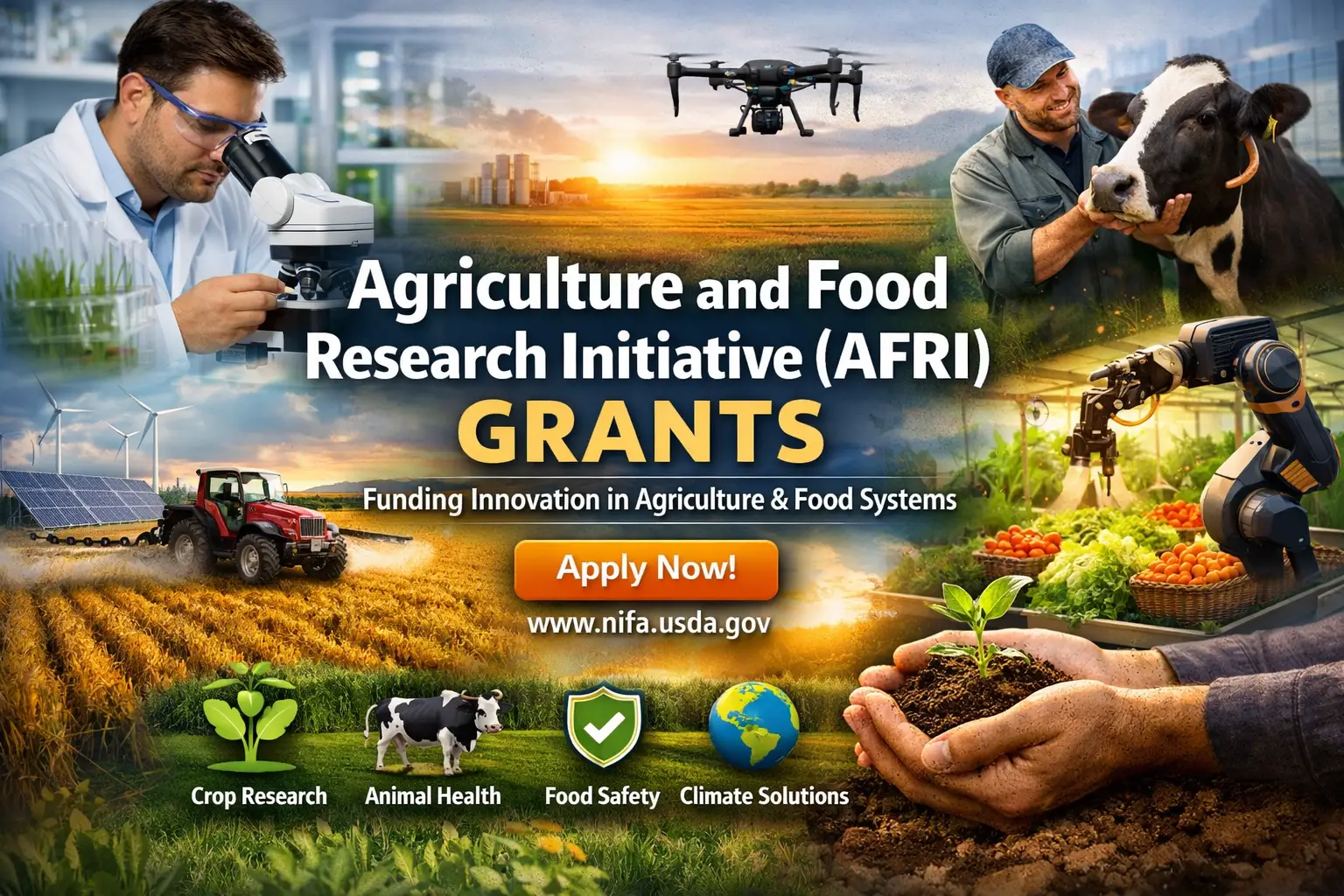
The Agriculture and Food Research Initiative (AFRI) is the flagship competitive grants program for agricultural sciences administered by the National Institute of Food and Agriculture (NIFA) under the United States Department of Agriculture (USDA). Designed to support groundbreaking research, innovative education programs, and impactful extension initiatives, AFRI plays a crucial role in addressing some of the most pressing challenges facing global agriculture, food systems, and rural development today.
Established by the 2008 Farm Bill and re-authorized in the 2018 Farm Bill, the AFRI program represents one of the largest federal investments in agricultural research and innovation. Congress authorized the initiative to receive up to $700 million annually, while the Consolidated Appropriations Act of 2024 currently funds AFRI at $445.2 million. Through this significant financial commitment, AFRI supports projects that advance agricultural science, strengthen food security, enhance environmental sustainability, and foster economic growth in rural communities.
As the world’s population is projected to reach nearly 10 billion by 2050, agriculture faces unprecedented challenges. These include increasing food production demands, climate variability, diminishing natural resources such as water and arable land, and the need for more resilient food systems. AFRI addresses these issues by funding interdisciplinary research and training the next generation of agricultural scientists and innovators who will help shape the future of global food systems.
AFRI’s Mission and Objectives
The Agriculture and Food Research Initiative is designed to promote scientific discovery, technological advancement, and educational development within agriculture and food sciences. The program funds projects that improve the efficiency, sustainability, and resilience of agricultural systems while also addressing public health, environmental protection, and economic stability.
Through its grants, AFRI seeks to:
-
Improve rural economies and support sustainable agricultural livelihoods.
-
Increase agricultural productivity and food production.
-
Stimulate the bioeconomy and encourage innovation in agricultural biotechnology.
-
Address climate change impacts and environmental sustainability challenges.
-
Ensure food safety, nutrition, and public health.
-
Enhance water management and availability for agricultural systems.
-
Strengthen national security through food and energy resilience.
-
Train the next generation of scientists, educators, and agricultural leaders.
AFRI Priority Areas
To address the most critical agricultural challenges, AFRI focuses on six priority areas identified by the Farm Bill. These priority areas guide the allocation of funding and ensure that projects align with national and global agricultural needs.
-
Plant Health and Production and Plant Products
This area supports research aimed at improving plant productivity, crop resilience, and sustainable crop management systems. Projects may involve plant genetics, pest management, crop protection technologies, and advanced breeding methods.
-
Animal Health and Production and Animal Products
Research in this area focuses on improving livestock health, animal production systems, animal welfare, and the safety and quality of animal products. Projects may explore disease prevention, genetics, nutrition, and sustainable livestock management.
-
Food Safety, Nutrition, and Health
AFRI funds research that improves food safety systems, strengthens food supply chains, and enhances human nutrition. Projects may address foodborne pathogens, dietary health, food processing technologies, and public health outcomes.
-
Bioenergy, Natural Resources, and Environment
This priority area focuses on sustainable management of natural resources and the development of renewable energy systems derived from agricultural sources. Research includes climate change mitigation, soil and water conservation, renewable bioenergy production, and ecosystem sustainability.
-
Agriculture Systems and Technology
Projects funded under this area develop innovative agricultural technologies that enhance efficiency, productivity, and sustainability. This includes robotics, artificial intelligence in agriculture, precision farming systems, and smart agricultural infrastructure.
-
Agriculture Economics and Rural Communities
This area supports research on economic sustainability, rural entrepreneurship, agricultural markets, and community development. Projects may explore policy solutions, economic resilience, and rural workforce development.
AFRI Project and Grant Types
AFRI provides multiple funding mechanisms designed to support projects of varying scale and scope. These grant types allow institutions and researchers to collaborate across disciplines and implement impactful agricultural innovations.
Standard Research, Education, and Extension Grants
These grants support individual projects that focus on advancing knowledge in agricultural sciences through research, educational programming, or extension services.
Integrated Projects
Integrated AFRI projects must combine at least two of the three core agricultural knowledge functions:
-
Research
-
Education
-
Extension
By integrating these components, projects ensure that scientific knowledge is effectively translated into practical solutions for farmers, communities, and policymakers.
Coordinated Agricultural Projects (CAP)
CAP grants support large-scale, multi-institutional research initiatives that address complex agricultural challenges. These projects often involve collaboration between universities, research institutions, and industry partners and can receive multi-million-dollar funding.
Food and Agricultural Science Enhancement (FASE) Grants
FASE grants aim to increase participation and competitiveness among institutions that may not traditionally receive large research grants. These grants help develop research capacity, support early-career scientists, and attract new talent to high-priority agricultural fields.
AFRI Funding Portfolio and Impact
The AFRI funding portfolio supports a wide range of projects that contribute to the sustainability and advancement of agriculture. These initiatives cover numerous sectors, including:
-
Crop production and plant science
-
Livestock management and animal health
-
Renewable energy and biofuel development
-
Forestry and agroforestry systems
-
Aquaculture and fisheries
-
Biotechnology and genetic innovation
-
Food safety and food system resilience
-
Rural entrepreneurship and community development
-
Human nutrition and public health
AFRI-funded projects also support job creation, technological innovation, and workforce development, helping build the next generation of agricultural professionals and researchers.
Eligible Institutions and Applicants
AFRI grants are awarded to a broad range of entities involved in agricultural research and education. Eligible applicants may include:
-
State agricultural experiment stations
-
Colleges, universities, and community colleges
-
University research foundations
-
Federal agencies and national laboratories
-
Nonprofit research organizations
-
Private companies and corporations
-
Individuals and collaborative research teams
Collaborative applications involving multiple institutions or interdisciplinary teams are strongly encouraged, particularly for projects addressing complex agricultural challenges.
International Partnerships and Collaboration
While AFRI primarily supports U.S.-based institutions, the program encourages international collaboration through research partnerships and joint initiatives. Global cooperation in agricultural research is essential for addressing cross-border challenges such as climate change, food security, and emerging plant and animal diseases.
AFRI also supports partnership initiatives with international organizations, including collaborations with research institutions around the world.
Application Process
Applications to AFRI are submitted in response to specific Notices of Funding Opportunities (NOFOs) released by NIFA. Each NOFO outlines the program priorities, eligibility criteria, funding limits, and application requirements for a particular funding cycle.
Applicants are encouraged to carefully review the requirements in the relevant NOFO before submitting their proposals.
In cases where applicants encounter legitimate delays due to unforeseen circumstances, NIFA has policies that allow for late application consideration. Applicants must notify the program contact listed in the NOFO and provide documentation explaining the delay.
AFRI Deadlines
Deadlines for AFRI funding opportunities vary depending on the specific Notice of Funding Opportunity (NOFO) and program area. Applicants should regularly monitor the official AFRI funding opportunities page to identify upcoming calls for proposals and submission deadlines.
The Future of Agricultural Innovation
As agriculture continues to face new challenges related to climate change, resource scarcity, population growth, and evolving food systems, programs like AFRI play a critical role in driving scientific discovery and innovation.
By funding interdisciplinary research, training future agricultural leaders, and fostering collaboration across institutions and countries, the Agriculture and Food Research Initiative is helping shape a more sustainable, resilient, and secure global food system for generations to come.
For more information click here
Discover more opportunities here