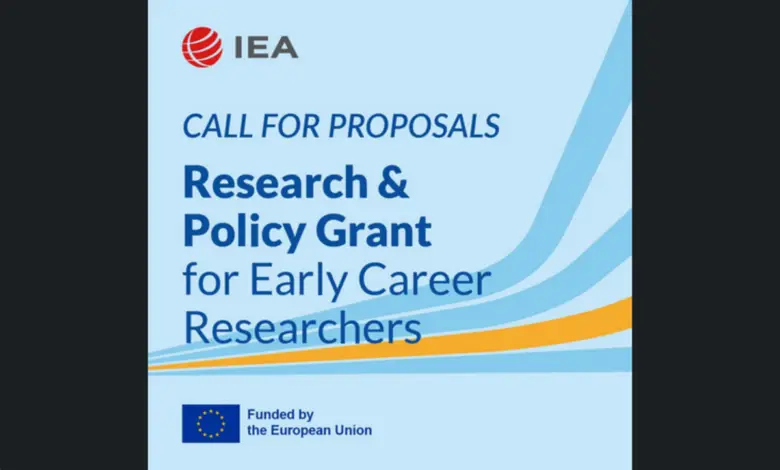
The European Commission (DG Education, Youth, Sport and Culture – DG EAC) in partnership with the International Association for the Evaluation of Educational Achievement (IEA) has launched the inaugural call for the Research & Policy (R&P) Grant for Early Career Researchers – 2025 Edition.
This competitive grant will award €20,000 per project to support high-quality, policy-relevant secondary analysis of IEA’s international large-scale assessment (ILSA) data. The initiative aims to strengthen research capacity, foster international collaboration, and generate evidence that informs education policy across the European Education Area (EEA).
Up to four projects will be funded.
Closing Date: 31 March 2026 (23:59 CET)
About the Research & Policy Grant
The R&P Grant is an annual initiative designed to:
-
Support promising early career education researchers
-
Encourage rigorous comparative secondary analyses of IEA datasets
-
Strengthen connections between research and EU education policy
-
Contribute to improving foundational and civic skills in Europe
Funded by the European Commission and coordinated by IEA, this program provides both financial support and expert guidance to researchers working with internationally recognized datasets such as:
-
TIMSS (Trends in International Mathematics and Science Study)
-
PIRLS (Progress in International Reading Literacy Study)
-
ICCS (International Civic and Citizenship Education Study)
-
ICILS (International Computer and Information Literacy Study)
What the Grant Offers
Successful applicants will receive:
Financial Support
-
€20,000 lump sum grant
-
Paid directly to the researcher or their institution
-
May cover researcher time, travel, software, dissemination, and networking costs
-
Research & Professional Development
-
12-month funded research period
-
Priority access to IEA Summer Training in Hamburg (August/September 2026)
-
Methodological and thematic expert support from IEA and DG EAC
-
Opportunities to engage in policy dialogue at the European level
-
Potential publication in IEA’s peer-reviewed journal Large-scale Assessments in Education
Grant recipients may also arrange optional short research visits (up to one week) at IEA Hamburg or relevant International Study Centers.
Research Topics
Proposals must address one of the following four thematic areas:
1. Foundational Skills in Primary Education (Grade 4)
Focus on reading, mathematics, and science competences and their determinants.
Example questions:
-
How do foundational skills co-develop in Grade 4?
-
Which school or teaching practices reduce socio-economic achievement gaps?
-
What learner or contextual factors promote balanced performance?
2. Digital Well-being and Social Media
Explore ICT use, digital literacy, engagement, and student well-being.
Example questions:
-
How does social media use affect academic achievement and engagement?
-
Is intensive ICT use associated with lower well-being?
-
Which school policies promote healthier digital behaviors?
3. Equity and Social Inclusion
Examine disparities related to socio-economic status, migration, language, disability, or geography.
Example questions:
-
How large are achievement gaps across demographic groups?
-
Which education systems combine high performance with high equity?
-
Which school characteristics reduce disparities?
4. Democratic Values and Citizenship
Study civic knowledge, democratic attitudes, participation, and school climate.
Example questions:
-
How do civic knowledge levels relate to democratic engagement?
-
Which school practices strengthen citizenship outcomes?
-
How do migration and socio-economic factors influence civic participation?
All proposals must demonstrate clear relevance to EU education policy and basic skills development.
Eligibility Criteria
Applicants must meet all eligibility requirements:
-
Be a PhD candidate OR have received their first doctoral degree within the last five years
(Alternatively: hold a master’s degree with fewer than 10 years of additional research experience) -
Propose a research project aligned with EU education priorities
-
Demonstrate experience or capacity in quantitative secondary analysis of IEA data
-
Have support from at least one senior researcher or policy expert (supervisor)
-
Arrange necessary visa and travel documentation (if required)
-
Demonstrate proficiency in English
Researchers of all nationalities are eligible to apply.
Project Expectations
Awarded researchers are expected to:
-
Conduct an original comparative secondary analysis
-
Participate in three project meetings (kick-off, intermediate, final)
-
Share preliminary findings with the European Commission before public release
-
Submit a final report (maximum 50 pages excluding annexes)
-
Present results at a seminar or technical meeting in Brussels
Preliminary results must be submitted to the European Commission at least six months before public dissemination. A six-month embargo period applies after draft submission.
The project must be completed within 12 months of the official grant start date.
Application Process
Applications must be submitted electronically via the IEA Grant Platform
Required documents include:
-
Structured research proposal (English; max. 2,100 words across sections)
-
Summary (200 words)
-
Background and literature (600 words)
-
Research questions & hypotheses (400 words)
-
Data & methodology (900 words)
-
-
CV with publication record
-
Proof of doctoral degree or enrollment
-
Supervisor recommendation letter
-
Host institution support letter (if applicable)
Applicants may act as principal investigator in only one application across the four thematic areas.
Selection Process
All proposals will be reviewed by an academic committee including experts from IEA and DG EAC.
Proposals will be evaluated based on four equally weighted criteria:
-
Scientific Quality & Policy Relevance
-
Use of Data & Methodological Rigor
-
Feasibility & Work Plan
-
Expertise & Capacity of the Researcher
To qualify for funding:
-
Minimum score of 3 in each criterion
-
Minimum total score of 15/20
A maximum of four projects will be funded annually (one per thematic area, where possible).
Applicants will be notified of results by 15 June 2026.
Key Dates
-
Call Opens: 3 February 2026
-
Submission Deadline: 31 March 2026 (23:59 CET)
-
Results Notification: By 15 June 2026
-
Training in Hamburg: Late August/Early September 2026
-
Project Completion: By 30 June 2027
-
End of Embargo: 31 October 2027
Why Apply?
This grant offers a unique opportunity for early career researchers to:
-
Access internationally recognized education datasets
-
Influence European education policy
-
Strengthen methodological expertise
-
Build international academic networks
-
Enhance publication prospects
If you are passionate about using data-driven research to strengthen foundational skills and education systems across Europe, this grant provides both the funding and institutional support to advance your work.
FOR MORE OPPORTUNITIES CLICK HERE