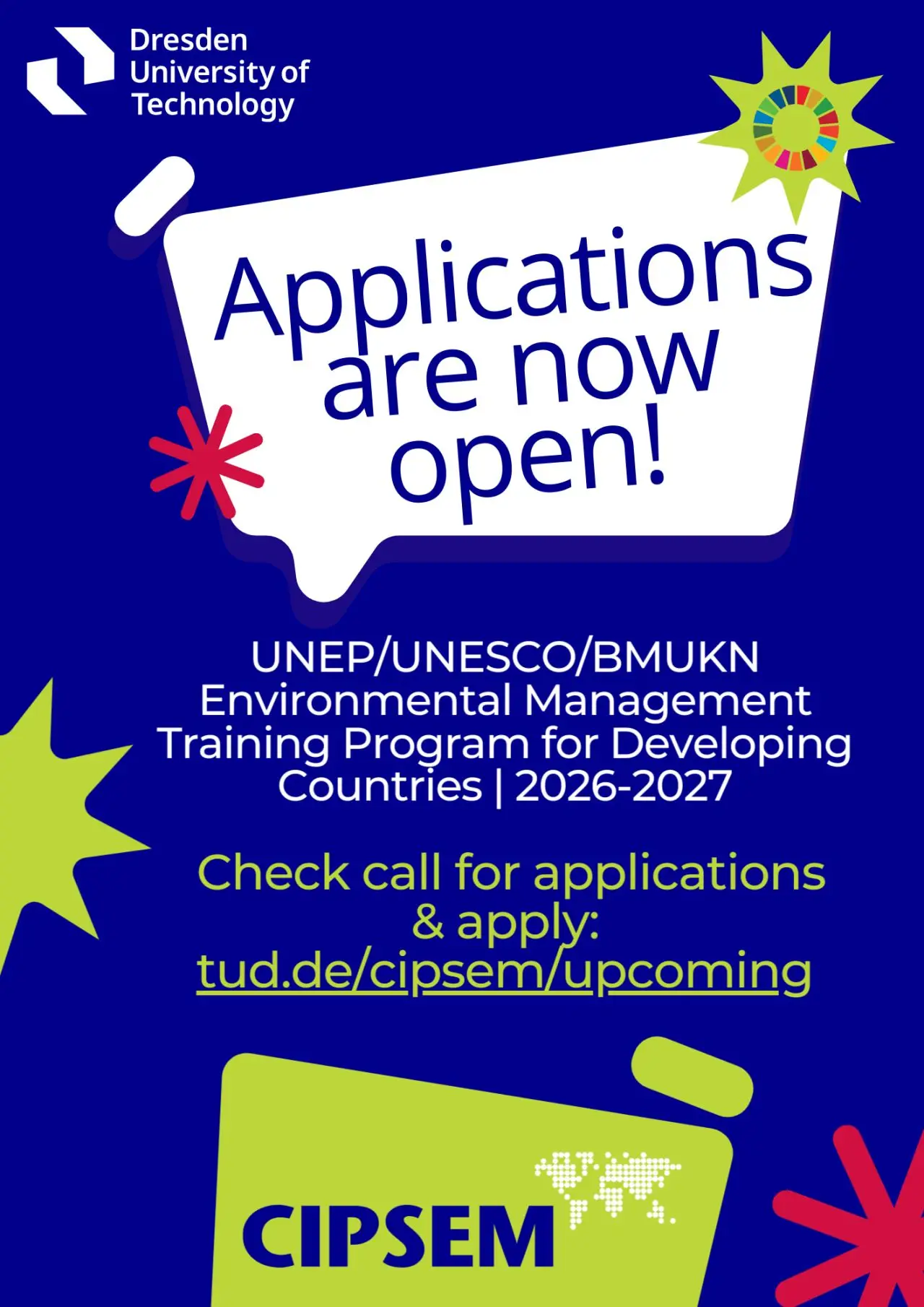
The Centre for International Postgraduate Studies of Environmental Management (CIPSEM) at TU Dresden will soon announce its full list of training opportunities for the 2026/27 cycle. Among these offerings are two flagship UNEP/UNESCO/BMUKN International Short Courses—SC94: Restoring the Green and SC95: Circular Solutions for Sustainable Construction and Land Management—as well as an alumni seminar on climate adaptation and resilience. Designed for professionals from developing countries and emerging economies, these courses combine scientific expertise, policy insights, and hands-on learning to strengthen environmental leadership worldwide.
CIPSEM SC94 – Restoring the Green: Sustainable Principles and Practices in Forest Restoration
The 94th International Short Course strengthens professional capacity in designing and implementing context-sensitive forest restoration strategies. Forest restoration plays a pivotal role in tackling ecological degradation, boosting climate resilience, and safeguarding local knowledge systems. Global commitments such as the UN Decade on Ecosystem Restoration, the Bonn Challenge, and the Paris Agreement highlight the urgent need for restoration frameworks that are both environmentally sound and socially inclusive.
Course Details
- Funding period: 16 August – 20 September 2026
- Course period: 20 August – 16 September 2026
- Duration: 4 weeks, full-time, on-site in Dresden
- Participants: 21 fellows
- Application period: 21 January – 24 February 2026
- Language: English
Course Concept
SC94 takes a multidisciplinary approach, weaving together ecological theory, field-based methodologies, governance considerations, and community engagement. Key topics include planetary boundaries, resilience thinking, succession dynamics, ecosystem services, innovative financing mechanisms such as carbon markets and Payments for Ecosystem Services, and systems-thinking for integrated restoration planning.
Participants learn how forest restoration is influenced by land tenure systems, traditional knowledge, market forces, and stakeholder participation. Through case studies and field excursions, the course equips fellows to analyze degradation drivers, design restoration plans, and apply adaptive management strategies.
Learning Targets
By the end of the course, participants will be able to:
- Explain the ecological principles behind forest restoration
- Diagnose forest degradation and assess site conditions
- Develop comprehensive restoration plans and monitoring frameworks
- Critically analyse global case studies
- Evaluate innovative financing mechanisms
- Communicate restoration strategies to diverse stakeholders
- Prepare Post-Training Action Plans to apply new knowledge in their professional contexts
Target Group
SC94 targets professionals in ministries, authorities, local government, and NGOs who work on forest restoration, resource sustainability, and environmental governance. Applicants need a relevant university degree, strong English skills, and formal delegation by their institution.
CIPSEM SC95 – Circular Solutions for Sustainable Construction and Land Management
The 95th International Short Course focuses on the urgent need for circular and sustainable approaches to construction and land management. With construction driving major resource use, waste generation, and carbon emissions, especially in rapidly urbanizing regions, circular strategies are vital for achieving climate and sustainability goals.
Course Details
- Funding period: 08 November – 12 December 2026
- Course period: 12 November – 09 December 2026
- Duration: 4 weeks, full-time, on-site in Dresden
- Participants: 21 fellows
- Application period: 27 January – 03 March 2026
- Language: English
Course Concept
SC95 explores resource efficiency, material circularity, lifecycle thinking, waste minimization, and sustainable land use planning. Participants examine how circular economy principles can reduce environmental impacts and reshape design, building processes, and land management systems.
Core topics include low-carbon materials, renewable construction resources, modular design, building disassembly, prefabrication, 3D printing, zoning regulations, nature-based solutions, and digital planning tools such as BIM and GIS.
Learning Targets
Participants will learn to:
- Describe sustainable construction and circular economy principles
- Assess environmental and social impacts of construction activities
- Develop strategies for material circularity and resource efficiency
- Apply lifecycle assessment concepts and digital planning tools
- Align construction decisions with sustainable land management practices
- Communicate and coordinate with stakeholders to promote circular approaches
Target Group
This course is designed for policymakers, planners, and practitioners involved in construction, land management, environmental conservation, and sustainable development. A relevant academic background and strong motivation to implement circular solutions are essential.
Application can be accessed from here.
To know more about such opportunities, click here.