The University of Konstanz in Germany is inviting applications for seven doctoral positions within the prestigious Cluster of Excellence titled “The Politics of Inequality.” This research initiative brings together leading scholars and early-career researchers who aim to better understand the political causes and consequences of inequality across societies. The program provides a unique opportunity for highly motivated graduates with strong academic backgrounds to pursue advanced doctoral research in an interdisciplinary environment.
This opportunity is designed for graduates who wish to contribute to innovative research that examines inequality from multiple perspectives. Doctoral candidates will work closely with internationally recognized scholars while developing independent research projects or collaborating within established research teams. The positions are embedded in a vibrant academic community that focuses on exploring how inequality influences political systems, social structures, and collective action.
Understanding the Research Focus: The Politics of Inequality
Inequality remains one of the most pressing challenges faced by societies around the world. Differences in access to education, income distribution, wealth accumulation, environmental resources, and political rights continue to shape opportunities and outcomes for individuals and communities. The Cluster of Excellence “The Politics of Inequality” was created to examine these complex dynamics and to better understand how inequality emerges, how it is perceived by individuals and groups, and how it influences political decision-making and social mobilization.
Researchers in the cluster explore several key questions. They examine how people perceive inequalities in their societies and how these perceptions influence their attitudes toward fairness, redistribution, and social justice. The cluster also studies how these perceptions can lead to collective mobilization, social movements, and political participation. In addition, scholars investigate how political institutions, policymakers, and other actors respond to inequalities and how these responses shape public policy and governance.
The cluster adopts a broad and multidimensional understanding of inequality. Rather than focusing only on economic disparities, it also considers inequalities related to education, environmental conditions, political rights, social privileges, and opportunities for participation in public life. This comprehensive perspective allows researchers to analyze how different forms of inequality interact with each other and influence political outcomes.
An Interdisciplinary Academic Environment
One of the most distinctive aspects of the Cluster of Excellence is its interdisciplinary approach. Addressing complex societal issues such as inequality requires insights from multiple academic disciplines. The cluster therefore brings together researchers from fields including political science, sociology, economics, linguistics, and other related social sciences.
By combining different theoretical frameworks and research methodologies, the cluster creates a dynamic environment where doctoral candidates can learn from diverse perspectives. Collaboration across disciplines allows researchers to develop more comprehensive analyses of inequality and its effects on societies and political systems.
Doctoral researchers will benefit from a collaborative atmosphere that encourages intellectual exchange, critical debate, and innovative thinking. Regular seminars, workshops, and academic events provide opportunities for doctoral candidates to present their work, receive feedback from experts, and engage with international scholars working on similar topics.
Overview of the Available PhD Positions
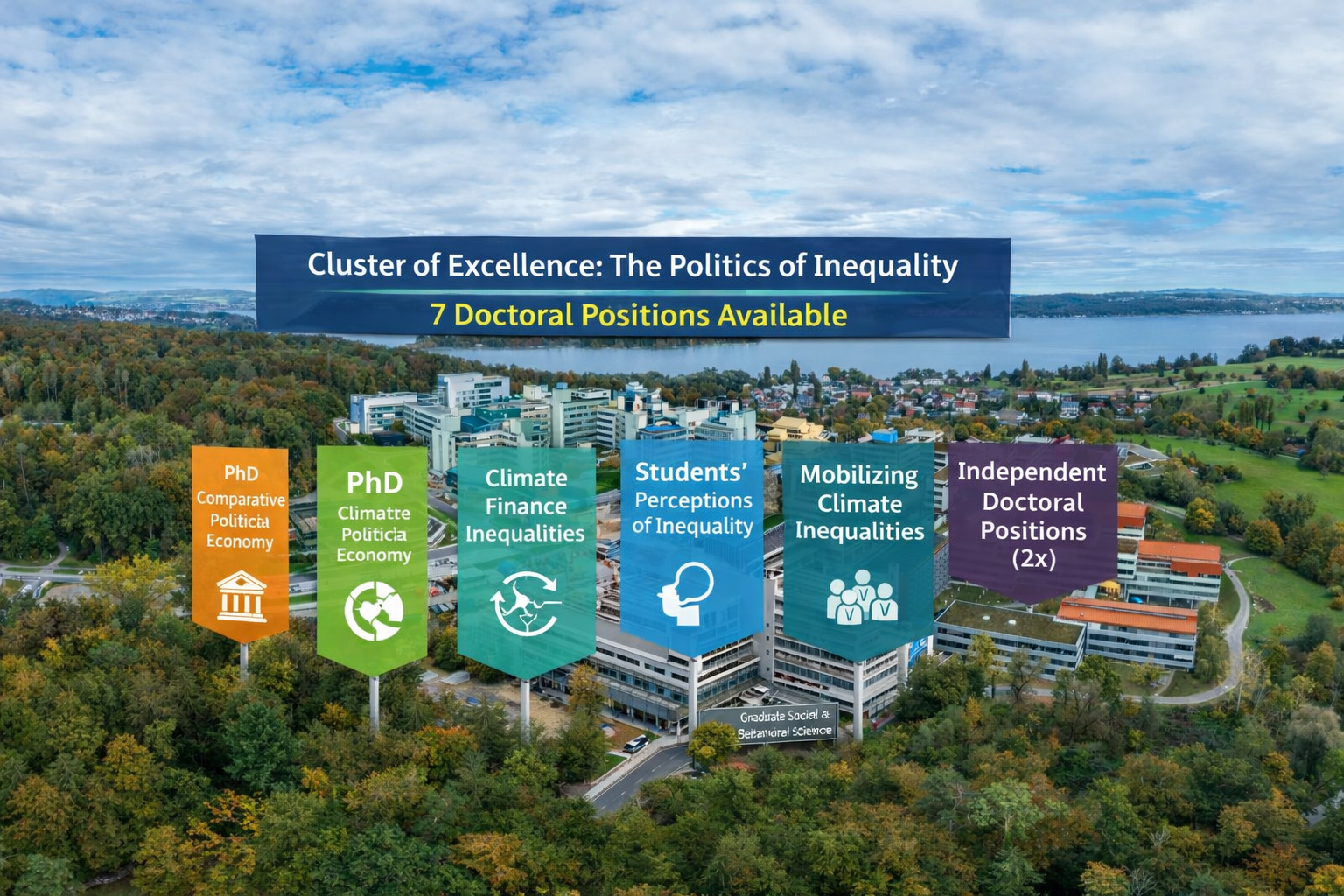
The Cluster of Excellence is offering seven doctoral positions across several research themes and projects. These positions provide flexibility for candidates to pursue either independent research or collaborative research within specific cluster projects.
Two of the positions are independent PhD positions, allowing candidates to design and conduct their own research projects related to the politics of inequality. These positions are ideal for applicants who have a well-developed research idea aligned with the cluster’s overarching themes.
Another position is located within the Working Group Comparative Political Economy, supervised by Prof. Dr. Marius R. Busemeyer. This research group focuses on the relationships between political institutions, economic systems, and social inequality, offering doctoral researchers the opportunity to examine policy-making processes and institutional responses to inequality.
One doctoral position is connected to the project “Inequalities in Climate Finance (ClimFin).” This research project investigates how financial resources for climate mitigation and adaptation are distributed globally and how these distributions may reinforce or reduce existing inequalities between countries and communities.
Another position is linked to the project “Students’ Perceptions of Inequality and Fairness.” This project focuses on how young people perceive inequality within educational systems and society, exploring how these perceptions influence their attitudes toward fairness, opportunity, and social mobility.
Finally, two doctoral positions are available in the research project “Mobilizing Climate Inequalities: From Perceptions to Participation (MOCLI).” This project examines how perceptions of climate-related inequalities influence political participation and collective action related to climate justice.
Each of these research areas contributes to the broader goal of understanding how inequality shapes political behavior, policy decisions, and social change.
Doctoral Training and Graduate School Integration
Successful candidates will be enrolled in the Graduate School of the Social and Behavioural Sciences at the University of Konstanz. Within this graduate school, doctoral researchers will specialize in Inequality Research, gaining advanced training in both theoretical and methodological approaches relevant to the study of inequality.
The graduate school provides structured doctoral training, including coursework, research seminars, professional development workshops, and opportunities to participate in international conferences. Doctoral candidates will receive guidance from experienced supervisors while also benefiting from peer collaboration within the doctoral community.
The academic environment at the University of Konstanz encourages independent research while providing strong institutional support. Doctoral candidates are expected to actively contribute to the intellectual life of the cluster by presenting research findings, participating in collaborative projects, and engaging with scholars from different disciplines.
Application Requirements and Process
Applicants interested in one of the seven doctoral positions must submit their applications through the official online application portal of the University of Konstanz. The application must include several important documents that allow the selection committee to assess the candidate’s academic background and research potential.
Required documents include:
-
A motivation letter explaining the applicant’s research interests and reasons for applying
-
A detailed curriculum vitae outlining academic achievements and relevant experience
-
A letter of reference from an academic referee
-
Academic certificates and transcripts demonstrating previous qualifications
Applicants must clearly indicate which PhD project they are applying for in both the statement of purpose and the electronic application form.
Following the initial evaluation process, shortlisted candidates may be asked to submit a three- to four-page research proposal that outlines their proposed doctoral research topic. This proposal should demonstrate how the applicant’s research aligns with the themes and objectives of the cluster.
Candidates who advance to the final stage of the selection process will be invited to participate in an interview scheduled for the first half of May.
Why Pursue a PhD at the University of Konstanz?
The University of Konstanz is internationally recognized for its excellence in research and teaching. As a member of Germany’s prestigious Excellence Strategy, the university hosts several high-impact research clusters and offers an inspiring environment for early-career researchers.
Doctoral candidates in the Cluster of Excellence “The Politics of Inequality” will benefit from:
-
Access to a world-class interdisciplinary research community
-
Opportunities to collaborate with leading scholars in the field
-
Participation in innovative research projects addressing global societal challenges
-
Structured doctoral training and professional development
-
Exposure to international academic networks and research collaborations
By joining this cluster, doctoral researchers will contribute to a deeper understanding of inequality and help generate knowledge that can inform public policy, political debate, and social change.
Application Deadline
The deadline to submit applications is 15 April 2026.
Interested applicants are encouraged to begin preparing their application materials early and submit them through the official University of Konstanz application portal before the deadline.
For more information click here
Discover more opportunities here